Adversa AIBook a demo

[ Coding Agent Security Platform ]

Prove what your AI did,per action

For risk, compliance, and audit teams

The platform records what every approved coding agent actually does and the rule that allowed or blocked each action — the per-action record that AI rules now ask for. A policy document no longer answers the question: regulators moved from “show me your AI policy” to “prove, per action, what your AI did, and that you could stop it”.

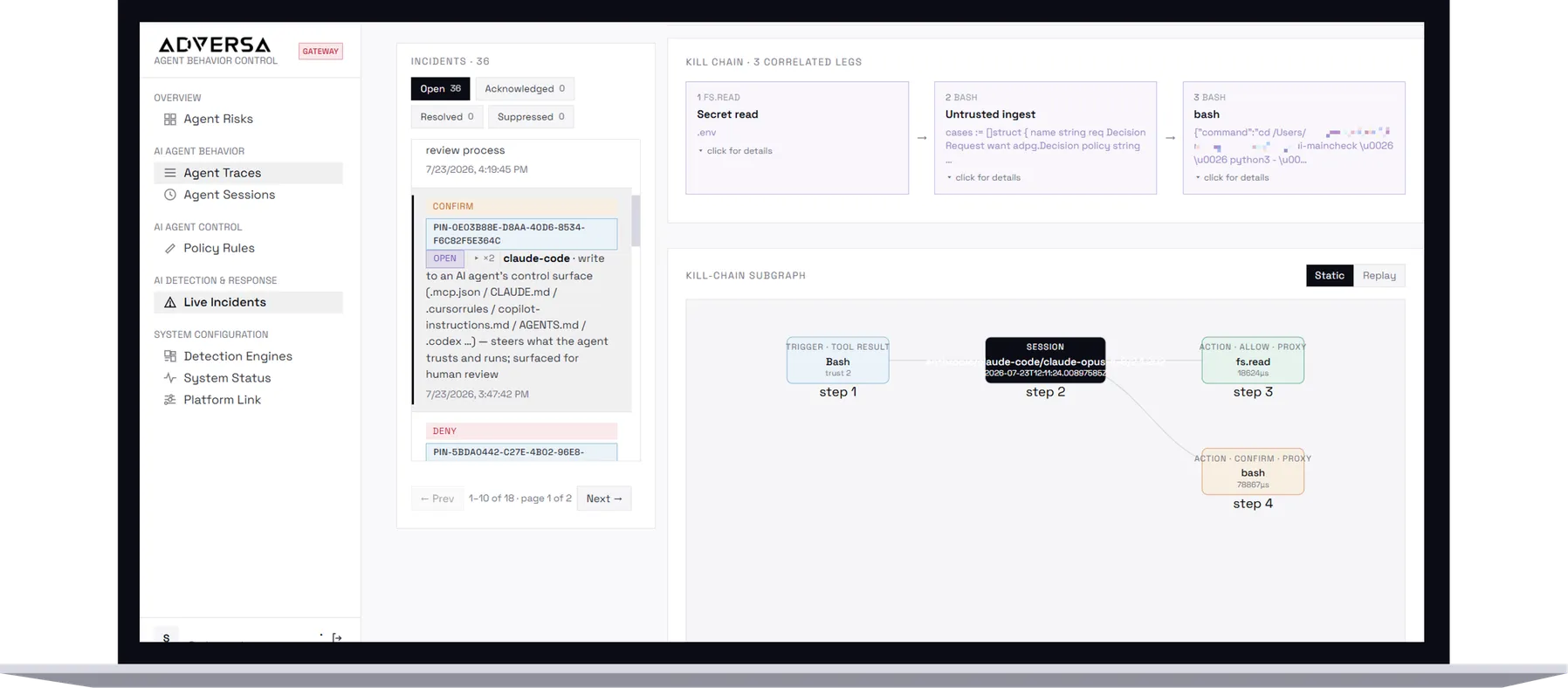
The coding agent security platform live-incidents dashboard

[ Why risk and compliance cares ]

Three questions, one record

Coding agents act with developer credentials on systems that reach production, and they entered the company as developer tooling, not as a reviewed risk. Three questions arrive on your desk regardless:

“What did your AI do, per action?”

[ 01 ]

The auditor

AI-specific requirements only grow, and they converge on the same demands: continuous monitoring, traceability, and a human in control.

A reporting clock that starts at the incident

[ 02 ]

The regulator

DORA-class windows need a complete event chain fast — and coding agents may count as third-party ICT.

A risk register entry with no control behind it

[ 03 ]

You

Coding agents hold production-reaching permissions. An entry with no control and no evidence is the gap every review finds.

One record answers all three.

[ Adversa AI behavior graph ]

Individual actions look harmless.The chain is the breach.

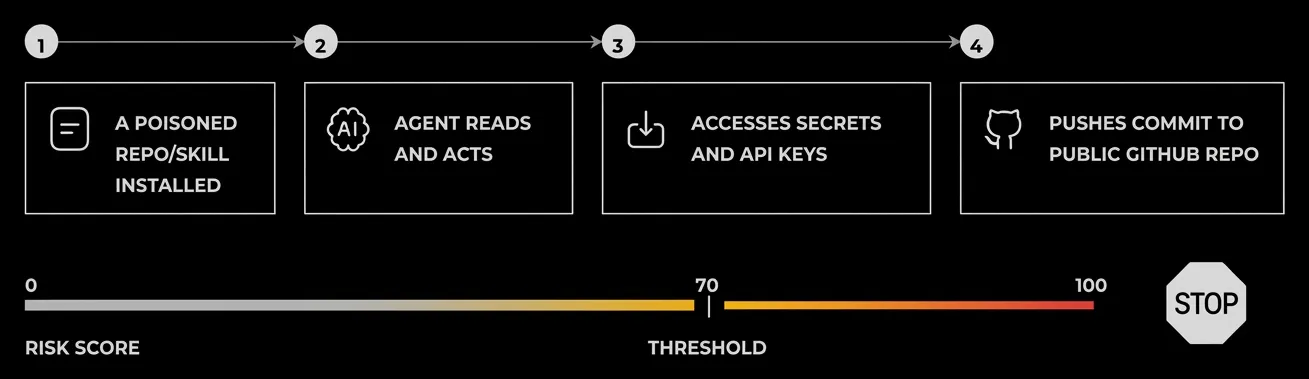
A poisoned repo or skill gets installed. The agent ingests it and starts acting on an attacker’s instructions. It reads a secret. It pushes a commit, your API keys inside. The agent was authorized for every step; no single event was suspicious, but the chain of events became the breach.

The platform builds an agent behavior graph: every step the agent reasons through and every action it takes, with its inputs and effects. Then it scores risk across the chain as it forms, across the model, the tools, and the machine. When the chain crosses the line, it’s blocked before it completes. And when something does go wrong, the same chain is what you hand the auditor: what happened, what was allowed, what was blocked, by which rule.

A four-step attack chain — a poisoned repo or skill installed, the agent reads and acts, secrets and API keys accessed, a commit pushed to a public GitHub repo — scored on one risk line that crosses the threshold, and the chain stopped

[ Proven in production ]

Caught in week one

Large financial institution, coding agents on macOS and Linux

A financial institution routed Codex, Claude Code, and Copilot through the platform: visibility from day one, and developers never noticed it was there. In the first week it stopped a real attack the AI gateway, EDR, and SIEM all missed: an agent absorbed a malicious skill, read internal API secrets, and tried to send them out.

0.2 ms

Median blocking decision, measured in production

Developers don’t feel it.

2,000:1

Raw signals per confirmed incident

No alert flood.

[ What we stop ]

The likely incident is a mistake at scale

Cyberattacks are only one of three ways agents cause damage. The same chain analysis catches the everyday risk too.

Rogue agent behavior

[ 01 ]

“What else is the agent doing?”

What we stop: Agents gradually expanding their own scope, acting far beyond the original task, runaway loops burning compute and tokens.

Mistakes: the everyday risk

[ 02 ]

“Can one wrong command drop production?”

What we stop: A “test cleanup” that drops the production database; a quick commit carrying your secrets into public code; a key pasted into a prompt.

Attacks

[ 03 ]

“Can someone hijack your agent?”

What we stop: Prompt injection and malicious context: a poisoned repo or skill, a rogue MCP server, and the exfiltration chain each one starts.

[ Compliance mapping ]

Built for what regulators want now

FrameworkRequired nowWhat you get
EU AI Act, Art. 12Automatic recording of AI actions across their lifecycle.A record of every action and the rule that allowed or blocked it.
EU AI Act, Art. 14A human must be able to intervene and stop.Pre-execution blocking is that intervention, not an after-the-fact alert.
DORAFast incident reporting; agents may count as third-party ICT.A complete event chain to classify and report inside the reporting window.
SR 11-7Ongoing monitoring of production models.A continuous, queryable record of model-driven actions.

Expected by auditors and counterparties

NIST AI RMF, ISO 42001, SOC 2, Japan’s AI Guidelines for Business, Singapore’s Model AI Governance Framework and MAS FEAT. They converge on the same demands: continuous monitoring, traceability, and a human in control. Mapped, evidenced, exportable in minutes.

[ The record ]

Every action, and the rule that decided it

  • A record of every agent action and the policy that approved or blocked it, export-ready for audit.
  • Continuous and queryable: which agent, in which session, under which credentials, and what it changed — plus what was blocked.
  • Mapped and evidenced: framework mappings exportable in minutes when the question arrives.
  • Honest coverage reporting: we tell you what we see and what we don’t, so your risk register stays accurate.

[ Our own posture ]

The vendor review, pre-answered

A control becomes part of your audit surface, so our posture comes first: SOC 2 Type I & II audited, ISO 27001 certified, GDPR compliant. Deployment where your policy requires — cloud or on-prem, per customer. Secrets are never stored, and what we ingest is documented in the trust pack.

  • SOC 2 Type II audited badge
  • ISO 27001 certified badge
  • SOC 2 Type I audited badge
  • GDPR compliant badge

[ Platform architecture ]

How it works

Two components, one platform:

Agent security gateway


Intercepts the agents’ own traffic: LLM calls, responses, tool executions, and MCP calls. Inline, or reading from the LLM/API gateway you already run.

Endpoint security sensor


Watches actions on the machine: files, shell, CI/CD. Strictly the agent’s actions, not the developer’s.

Harness hooks and direct reads of the top vendors’ compliance APIs complete the capture. Both components feed one policy engine. Every action is logged into the agent behavior graph; the chain is scored as a whole; the response follows your policies: warn, deny, or human-in-the-loop.

[ Policies ]

Protected on day one,no rule-writing required

Over 300 policies ship by default

Our red team maintains the rulebook: every known coding agent attack technique and public incident, covered. You start protected without writing a thing.

Your policies in plain English

Say “these developers’ agents can’t touch AWS”. The platform turns the sentence into a precise, enforceable policy. Generated policies are validated, simulated, versioned, and approved before they go live — a change-controlled path from requirement to control.

Stable by design

Rules match the shape of dangerous behavior, with content as one signal alongside trust state, action type, identity, and provenance. A reworded attack trips the same rule.

[ Trust & Proof ]

The team your auditors already cite

Adversa AI experts are co-leads and core members of industry-defining frameworks and initiatives: NIST AI RMF, OWASP ASI, CoSAI, CSA AI CM. Trusted by Fortune 500 enterprises including top banks, insurance companies, fintech, Big Four, and automotive enterprises.

Analyst recognition

Standards leadership

A decade of adversarial research

20+ industry awards

20+ industry awards

[ See it yourself ]

The record, on your own traffic

The demo takes 30 minutes. If it fits, a scoped observe-mode pilot follows: one dev team, the agents you’ve approved. The readout includes the record itself — every action, the rule, the verdict — export-ready, alongside the would-have-blocked list that justifies turning enforcement on.

Form not loading? Open it in a new tab.

Frequently asked questions

Is coding agent security a compliance control?

The runtime half of one. The record of every action and the rule that allowed or blocked it is what EU AI Act Art. 12 asks for; pre-execution blocking is the human intervention of Art. 14; the complete event chain is what DORA’s reporting clock needs.

Does the EU AI Act reach coding agents?

Scoping is your counsel’s call — it depends on how your organization’s AI use is classified. What the platform supplies either way is what Art. 12 and Art. 14 describe: automatic recording of AI actions, and a human able to intervene and stop before execution.

How does this help with DORA?

Incident reporting runs on a clock, and agents may count as third-party ICT. The platform gives you the complete event chain to classify and report inside the window, with the rule and the verdict attached.

Is this employee monitoring? We have works councils.

The sensor watches strictly the agent’s actions, not the developer’s, and coverage is scoped to the coding agents your company approved. That design boundary is documented — it is the distinction the works-council conversation needs.

Where does our data live, and what do you retain?

Cloud or on-prem, per customer; on-prem, we retain nothing. We collect action telemetry, not your codebase; secrets are never stored, and what we ingest is documented in the trust pack.

What can we export?

The event stream to your SIEM with the full chain attached; the action record, export-ready for audit; and framework mappings, evidenced and exportable in minutes.

What do you deliberately not claim?

We cover the sanctioned fleet: the agents you’ve approved and routed. We don’t discover unknown tools across the estate — coverage reporting shows which approved agents are enrolled and where the gaps are, so your risk register reflects what is actually controlled.

Which coding agents are covered?

The agents you’ve approved — Claude Code, Copilot, Cursor, Codex, and what comes next. Policies hold when developers switch tools, or when your model router switches providers.

Can we run it without blocking anything at first?

Yes — pilots start in observe mode: watch, log, and review the would-have-blocked list with its false positive rate on your own traffic. When you turn enforcement on, policies can warn before they block, or require a human in the loop. Blocking is per policy, when you decide.

What does a pilot look like?

14–30 days, one dev team, observe mode only, success criteria agreed in writing before the start — including measured overhead on your own traffic and the would-have-blocked list that justifies turning blocking on.