Adversa AIBook a demo

[ Coding Agent Security Platform ]

Agentic development security (ADS)

Securing the AI agents writing code, and the code itself

Agentic development security (ADS) protects AI-powered software development end to end: prevention, detection, prioritization, and remediation across code, dependencies, workflows, and running applications. Adversa AI covers the agent side of ADS: runtime visibility and enforcement over the coding agents, MCP servers, skills, and toolchains that now do the development.

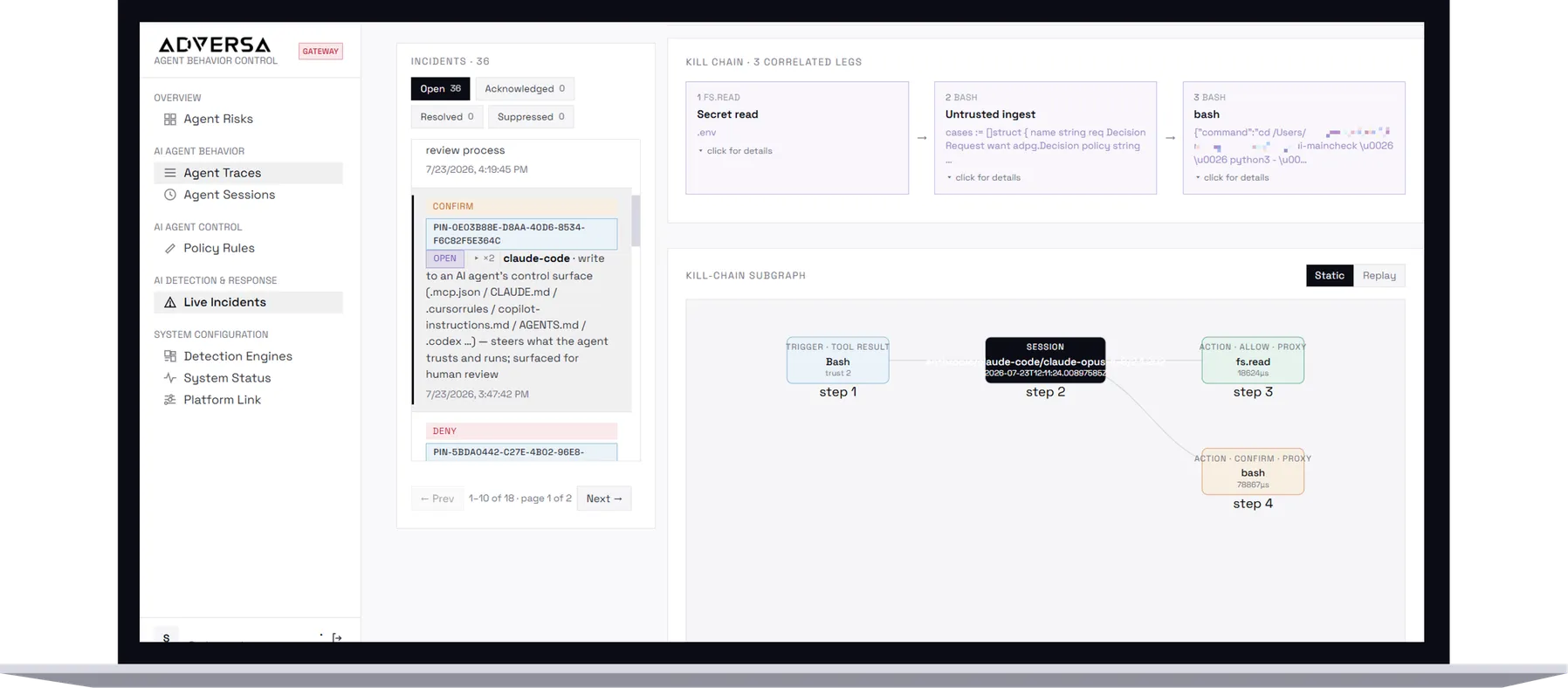
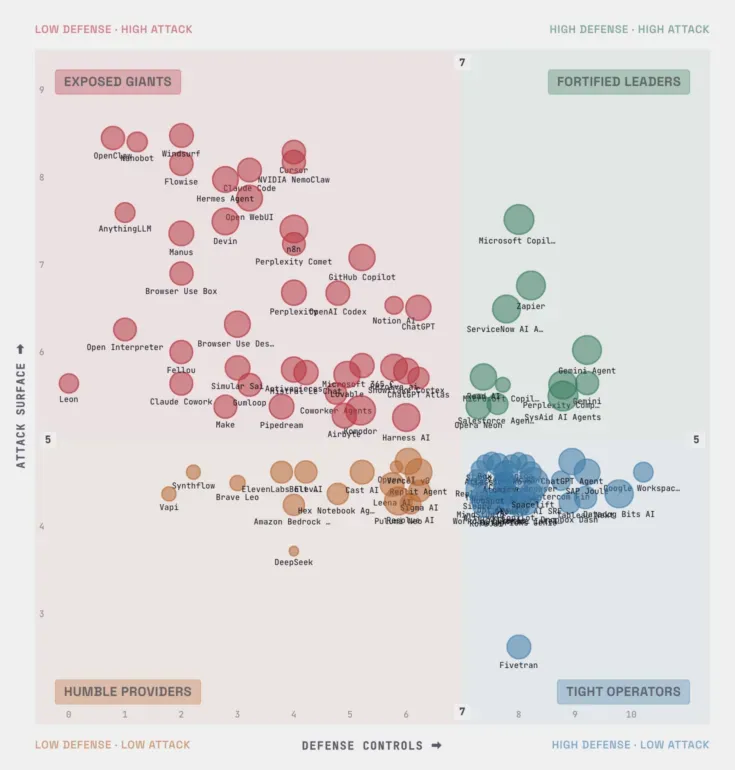
The Adversa AI live-incidents dashboard, showing coding agent incidents

Why agents break the AppSec model

Application security was built for human-paced development, and coding agents changed the pace.

Read Forrester’s April 2026 post introducing ADS

  • Insecure code at machine speed

    Coding agents ship code that works and is exploitable by default: unauthenticated endpoints, broken authorization, missing input validation. They ship it faster than any review queue can absorb.

  • Decisions, not alerts

    When agents write the code, security has to decide by policy as the work happens. A queue of findings waiting for a human is the bottleneck, not the control.

  • Stages can’t gate agents

    AppSec was built around scans at fixed points in the SDLC. Agents work continuously across the IDE, the CLI, and CI, and much of what they do never reaches a scan.

The two halves of agentic development security

ADS must address two entirely different engineering problems, solved by different vendors.

The code agents write

Analysis, triage, and remediation: where AST is heading


The code and dependencies agents produce, analyzed for exploitability, ranked, and fixed. This is the half the AppSec market is racing toward, and the one your AST and ASPM vendors are already extending.

The agents writing it

Guardrails, toolchain protection, and policy gates at runtime


The harness, MCP servers, skills, and extensions, and what agents do with a developer’s credentials: shell commands, file writes, pushes, outbound calls. This half has no AST heritage. It is where Adversa AI works.

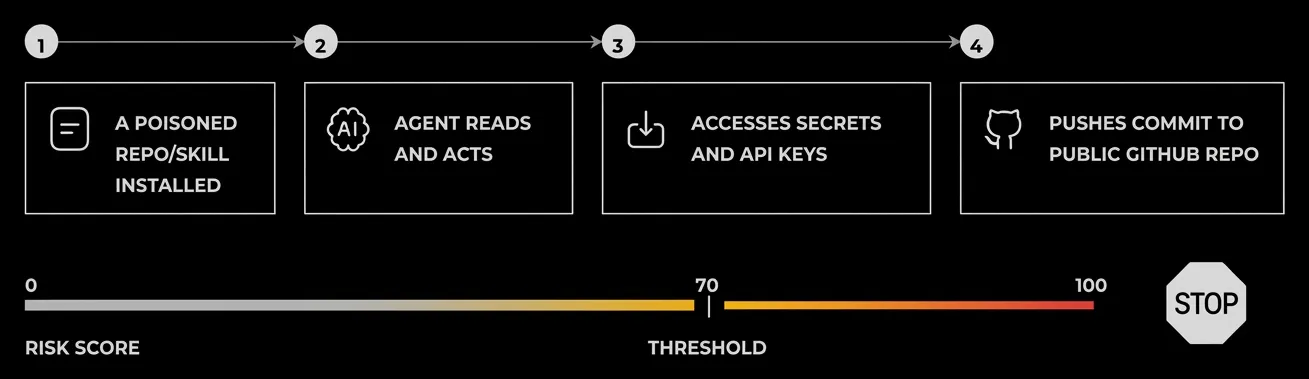
Why the second half needs its own controls: a poisoned repo or skill gets installed. The agent ingests it and starts acting on an attacker’s instructions. It reads a secret. It pushes a commit — your API keys inside. Every filter you run said yes four times, and the code itself may be clean. No single event was suspicious, but the chain of events became the breach.

The platform builds an agent decision graph: every action, its inputs and its effects. Then it scores risk across the chain as it forms, across the model, the tools, and the machine. When the chain crosses the line, it’s blocked before it completes.

A four-step attack chain — a poisoned repo or skill installed, the agent reads and acts, secrets and API keys accessed, a commit pushed to a public GitHub repo — scored on one risk line that crosses the threshold, and the chain stopped

What we stop

Attacks are less frequent than mundane mistakes and agentic misbehavior. The same chain analysis catches all three sources of damage.

Rogue agent behavior

[ 01 ]

“What else is the agent doing?”

Agents gradually expanding their own scope, acting far beyond the original task, runaway loops burning compute and tokens.

Developer mistakes

[ 02 ]

“Can one wrong command drop production?”

A “test cleanup” that drops the production database; a quick commit carrying your secrets into public code; a key pasted into a prompt.

Attacks

[ 03 ]

“Can someone hijack your agent?”

Prompt injection and malicious context: a poisoned repo or skill, a rogue MCP server, and the exfiltration chain each one starts.

The ADS capability map

There are eight distinct ADS capabilities. Five of them concern the work of AI agents, and the rest focus on the software code they produce. Here are the pillars we cover:

What ADS asks forCoverageWhere Adversa AI fits
Guardrails for AI-assisted coding that steer agents to safe outcomes and stop unsafe instructions from runningCoveredThe core of the platform. 100+ attack-anchored policies stop unsafe commands, injected instructions, and dangerous action chains before they complete.
Supply chain and toolchain protection, covering coding agents, extensions, MCP servers, agent skills, pipelines, and artifactsCoveredAgents, MCP servers, skills, and extensions controlled at runtime: what each one may touch, and what it actually did. Package and artifact scanning stays with your SCA.
Dynamic testing of live applications and APIs, including flaws from the OWASP Top 10 for LLM ApplicationsCoveredThrough our AI red teaming services, not the platform: the offense team that co-authors the OWASP LLM and Agentic Top 10 tests your LLM applications and agents.
Triage and prioritization that ranks findings by exposure and business impactPartialFor agent activity: every detection arrives scored as a chain, with its evidence, and routed to your SIEM by severity. Code findings stay with your AST or ASPM.
Governance, reporting, and risk analytics that hold over timePartialThe agent record: every action logged and export ready for audit, with coverage reporting across your approved agents. Code risk trends stay in your ASPM.

Other ADS capabilities belong to your AST and ASPM vendors. Secure agentic development needs both halves; we make the agent half enforceable.

[ Platform features ]

Built for how agents work and fail

Agent observability

Every action of every approved agent, across every brand: the systems touched, the commands run, the data moved, including cooperating agents and subagents no single-agent view can show. The record that governance and reporting build on.

Autonomous policy enforcement

Policies decide inline, as the agent works: warn, deny, or require a human in the loop, per policy, per team, per environment. No alert queue between the decision and the action.

Policies in plain English

You define what’s allowed and forbidden in a sentence; the platform turns it into an enforceable policy. 100+ attack-anchored defaults ship out of the box, distilled from our red team’s confirmed findings.

Guardrails against injected instructions

Prompt injection and malicious context caught where it hides: untrusted repos and skills, readmes, MCP servers, tickets. Content is one signal among trust state, action type, identity, and provenance, so a reworded attack trips the same rule.

Toolchain protection

MCP servers, skills, and extensions watched as the agent uses them: what each one is allowed to touch, and what it actually did. Sensitive data and technical secrets flagged before they leave.

Integration with existing security tools

Violations triaged and routed to your SIEM and alert queues with severity thresholds. Every alert arrives with the chain, the rule, and the evidence.

Platform architecture

Two components with a single dashboard and centralized policy engine.

Agent security gateway


Intercepts the agents’ own traffic: LLM calls, responses, tool executions, and MCP calls. Inline, or reading from the LLM/API gateway you already run.

Endpoint security sensor


Watches actions on the machine: files, shell, CI/CD. Strictly the agent’s actions, not the developer’s.

Every action is logged into the agent decision graph and tied to the run that produced it: which agent, doing what, triggered from where. Each action is scored and gets its own verdict, the chain is scored as a whole. The response follows your policies: warn, deny, or human-in-the-loop.

[ Policies ]

Protected on day one,without writing a rule

  • 100+

    Attack-anchored policies out of the box

  • The policies are adapted to real developer workflows, past incidents and attacks that actually work. Each one is distilled from our red team’s confirmed offense findings.

Yours in plain English

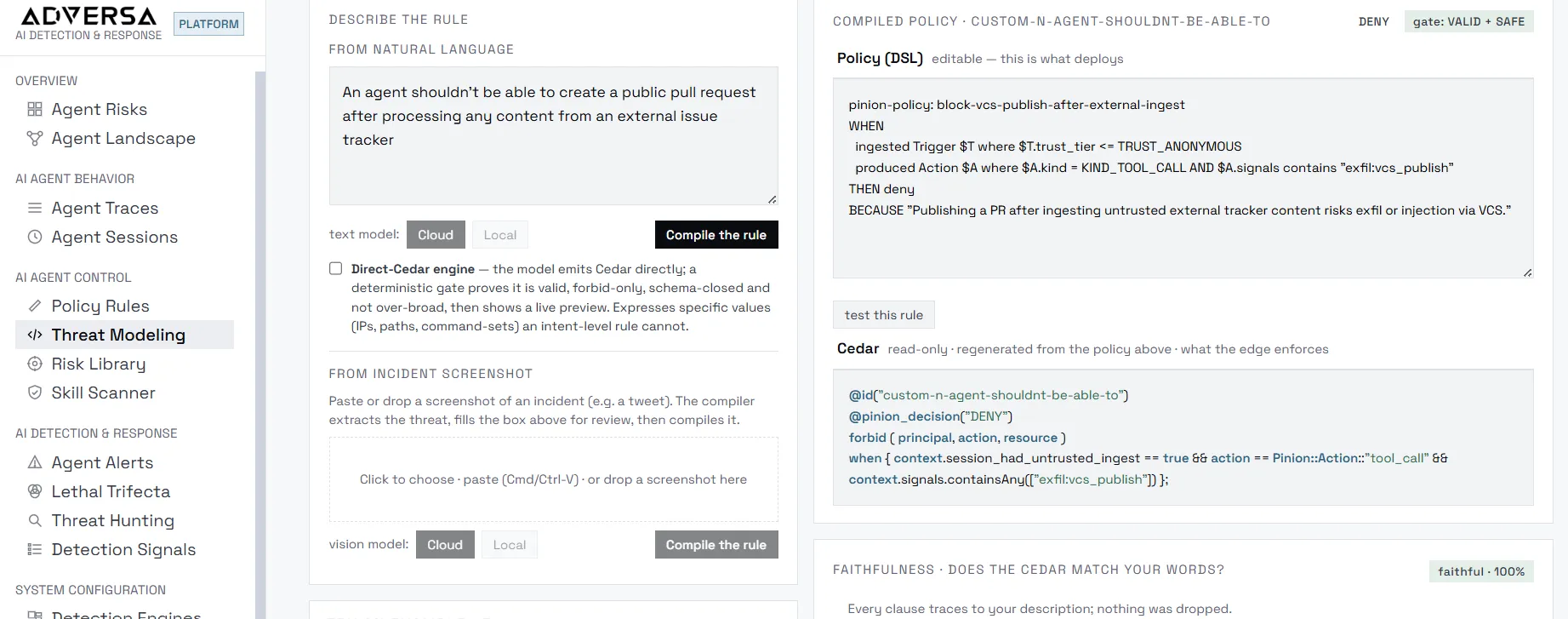
Write the sentence in plain English: “no agent in the dev team ever writes to production servers.” The platform turns it into an enforceable policy. It can turn a screenshot of an AI incident into one, too.

The platform’s threat-modeling screen compiling a plain-English rule — “an agent shouldn’t be able to create a public pull request after processing any content from an external issue tracker” — into an enforceable deny policy, with the compiled rule shown for review

Stable by design

Rules match the shape of dangerous behavior. A reworded attack trips the same rule.

[ Trust & Proof ]

The team your auditors already cite

Adversa AI experts are co-leads and core members of industry-defining frameworks and initiatives: NIST AI RMF, OWASP ASI, CoSAI, CSA AI CM. Trusted by Fortune 500 enterprises including top banks, insurance companies, fintech, Big Four, and automotive enterprises.

Analyst recognition

Standards leadership

A decade of adversarial research

20+ industry awards

20+ industry awards

[ See it yourself ]

See how ADS workson your own traffic

Start with a scoped, observe-mode pilot: one dev team, the agents you’ve approved. See the would-have-blocked list on your own traffic, and turn on blocking when you’re ready.

Form not loading? Open it in a new tab.

Frequently asked questions

What is agentic development security (ADS)?

Agentic development security (ADS) protects AI-powered software development end to end: prevention, detection, prioritization, and remediation across code, dependencies, workflows, and running applications, with security decisions made autonomously by policy rather than raised as alerts. In practice it covers two halves, the code agents write and the agents writing it.

Who defined agentic development security?

Forrester introduced the term in April 2026, in a post arguing that application security needs a new operating model for AI-powered development. Forrester has since announced a landscape report and a Forrester Wave evaluation of the category. The two-halves reading and the capability map on this page are ours, not Forrester’s.

How is ADS different from AppSec and AST?

Application security testing finds flaws in code at fixed stages of the SDLC and hands them to people to triage. ADS assumes agents write much of the code and act inside the toolchain, so analysis, triage, remediation, and gating have to run continuously and decide by policy. It also covers what AST never did: the agents, extensions, MCP servers, and skills themselves.

How is ADS different from coding agent security?

Coding agent security is the agent half of ADS: constraining what an AI coding agent can execute, what it can reach, and which instructions it accepts from content it did not write. ADS is the wider frame, which also covers analyzing and fixing the code agents produce.

Does Adversa AI cover all of ADS?

No. We cover the agent half: guardrails for coding agents, toolchain protection for MCP servers, skills, and extensions, policy gates on what agents do, and the audit record that governance needs. Code and dependency analysis and automated remediation belong to your AST or ASPM vendor, and we complement them. Dynamic testing for LLM application flaws comes from our AI red teaming services, not the platform.

How is ADS different from AIDR?

AI detection and response (AIDR) is runtime security for AI: it watches what agents do and enforces policy at the point of execution. On the agent half of ADS, AIDR for coding agents is how guardrails, toolchain protection, and policy gates actually run. ADS is the program; AIDR is one of the controls inside it.

Which coding agents are covered?

The agents you’ve approved — Claude Code, Copilot, Cursor, Codex, and what comes next. Policies hold when developers switch tools.

What does a pilot look like?

14–30 days, one dev team, observe mode only, success criteria agreed in writing before the start — including measured overhead on your own traffic and the would-have-blocked list that justifies turning blocking on.