Adversa AIBook a demo

[ Coding Agent Security Platform ]

Agents that don’t break prod

For AI platform, engineering, and SRE leaders

A sub-millisecond check between your coding agents and the destructive command, designed to fail open: a crash in our layer never blocks a developer. Code review and CI can’t carry this job — the dropped table and the leaked key happen in the session, before any pipeline runs.

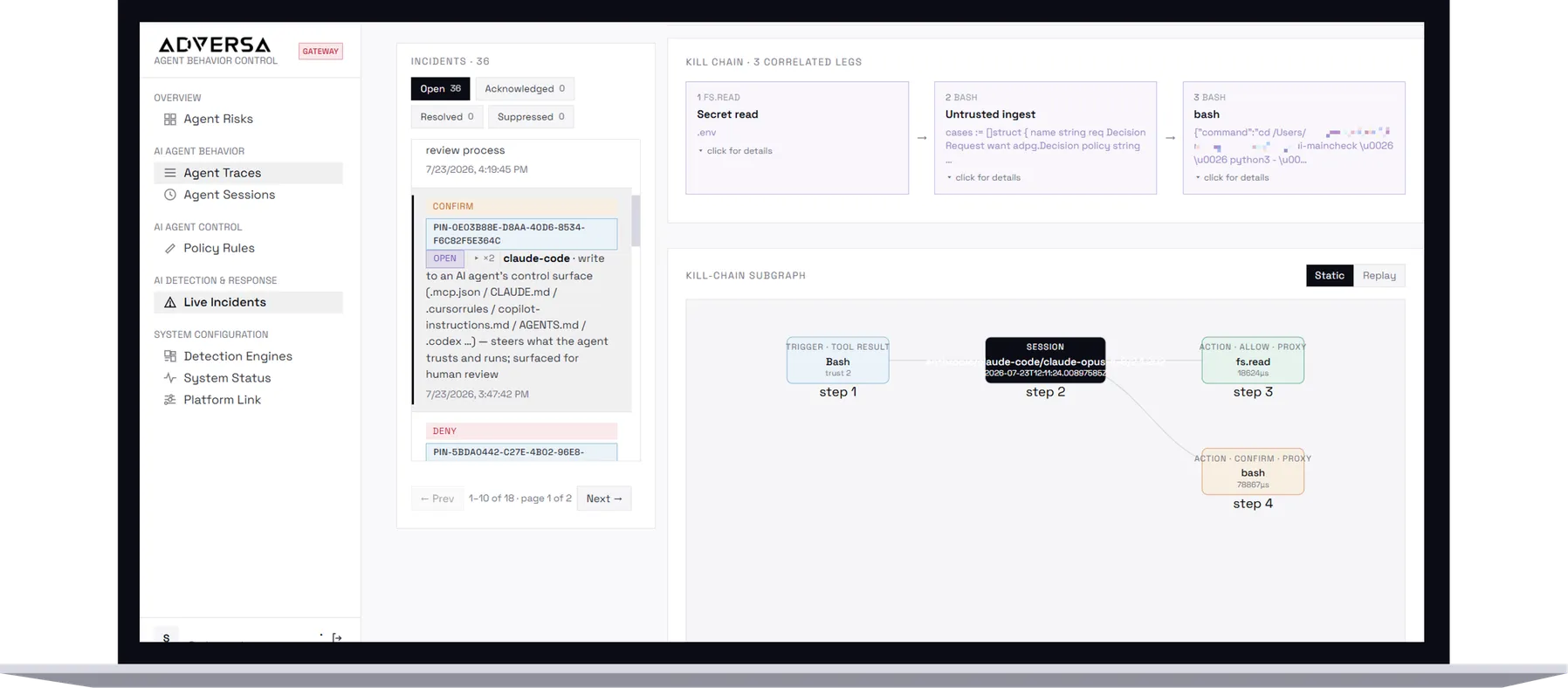
The coding agent security platform live-incidents dashboard

[ Why engineering cares ]

You own the rollout.You also own the 3 a.m. page.

You approved the coding agents, you run the gateway and the endpoint fleet, and when an agent does something destructive, the recovery lands on your team. Three realities shape the problem:

Mistakes are the common case

[ 01 ]

A cleanup prompt that hits the wrong database. A force-push to a protected branch. The wrong package installed. A key carried into a public commit. No attacker involved, and still your incident.

Security needs controls; you own the infrastructure

[ 02 ]

The purchase is security-led, but the gateway, the endpoint management, SSO, and CI are yours. Whatever gets deployed has to respect your stack and your latency budget.

The fleet keeps changing

[ 03 ]

New agent brands, new harnesses, a model router behind them. Policy that has to be rebuilt per tool is a tax on every change you ship.

[ The entry ticket ]

Built to cost your developers nothing

  • Sub-millisecond median decision, measured in production; the heaviest paths stay under 50 ms.
  • Fails open. A crash or overload in our layer never blocks a developer.
  • No change to how developers work. First signal in minutes.
  • Strictly the agent’s actions, not the developer’s. The sensor watches AI activity only and runs beside your EDR.
  • Your gateway stays. We read from it selectively, or run as one where none exists.

[ The reliability win ]

It fixes the thing you actually want fixed

The same chain analysis that serves security catches the operational failures first: leaked secrets, dropped production tables, wrong packages, unreviewed deploys, runaway loops burning compute and tokens — caught before they execute, not found in the postmortem. When the platform flags a near-miss, engineering gets the save.

[ Adversa AI behavior graph ]

Individual actions look harmless.The chain is the breach.

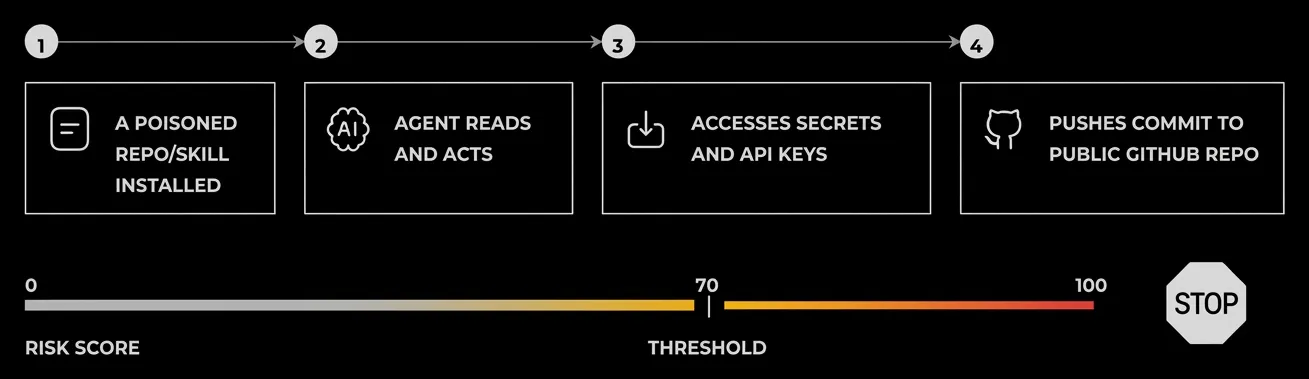
A poisoned repo or skill gets installed. The agent ingests it and starts acting on an attacker’s instructions. It reads a secret. It pushes a commit — your API keys inside. No single event was suspicious, but the chain of events became the breach.

The platform builds an agent behavior graph: every step the agent reasons through and every action it takes, with its inputs and effects. Then it scores risk across the chain as it forms, across the model, the tools, and the machine. When the chain crosses the line, it’s blocked before it completes. The developer gets a clear error and keeps working.

A four-step attack chain — a poisoned repo or skill installed, the agent reads and acts, secrets and API keys accessed, a commit pushed to a public GitHub repo — scored on one risk line that crosses the threshold, and the chain stopped

[ Proven in production ]

Caught in week one

Large financial institution, coding agents on macOS and Linux

A financial institution routed Codex, Claude Code, and Copilot through the platform: visibility from day one, and developers never noticed it was there. In the first week it stopped a real attack the AI gateway, EDR, and SIEM all missed: an agent absorbed a malicious skill, read internal API secrets, and tried to send them out.

0.2 ms

Median blocking decision, measured in production

Developers don’t feel it.

2,000:1

Raw signals per confirmed incident

No alert flood.

[ Your stack stays yours ]

Keeps your gateway.Respects your router.

An AI gateway is for traffic control, not risk management. Yours is the right infrastructure, and it stays; we enrich it with the layers it was never built for. Policies hold when developers switch tools, or when your model router switches providers — self-hosted and API models both.

CapabilityA typical AI gatewayCoding Agent Security Platform
Routing LLM traffic for models and agentsYes — keep itReads selectively from your gateway, or runs as a standalone gateway
Monitoring tool execution and MCP calls, separated from model trafficLLM traffic onlyYes, logging which systems are touched, which commands run
Recognition of what’s actually happening (semantic analysis of the traffic)NoYes
Combining steps into chains, risk scored progressively as the chain buildsNo — each step analyzed separatelyYes — chain risk scoring on the agent behavior graph
Endpoint agent runtime monitoring (files, shell, CI/CD)NoYes
Baseline policies: dangerous events and attacks caught by defaultYour team must write and maintain rules300+ default policies out of the box, updated by our offense team
EnforcementPrompt-level filtersWarn, deny, or human-in-the-loop at action level

The hidden cost of homegrown rules is maintenance: techniques against coding agents evolve monthly, and somebody has to keep detection current. Our offense and research teams do it for a living, so it doesn’t become your platform team’s backlog.

[ Autonomy ]

The safety net that unlocks autonomy

With inline enforcement and a recorded would-have-blocked trail, higher autonomy modes stop being a leap of faith. Security approves more agent use, not less, when the control exists — and the evidence for that conversation comes out of the platform, not out of a meeting.

[ Rollout ]

Days, not a procurement cycle

Rollout is a config push through the endpoint management you already run plus an SSO group — or a manual one-line config change. Start with one team and widen from there; the scope starts small, not the coverage. Observe mode first; blocking per policy, when you decide.

[ Platform architecture ]

How it works

Two components, one platform:

Agent security gateway


Intercepts the agents’ own traffic: LLM calls, responses, tool executions, and MCP calls. Inline, or reading from the LLM/API gateway you already run.

Endpoint security sensor


Watches actions on the machine: files, shell, CI/CD. Strictly the agent’s actions, not the developer’s.

Harness hooks and direct reads of the top vendors’ compliance APIs complete the capture. Both components feed one policy engine; the chain is scored as a whole; the response follows your policies: warn, deny, or human-in-the-loop. Cloud or on-prem.

[ Policies ]

Protected on day one,no rule-writing required

Over 300 policies ship by default

Our red team maintains the rulebook: every known coding agent attack technique and public incident, covered. You start protected without writing a thing.

Your policies in plain English

Say “no agent in the dev team ever writes to production servers”. The platform turns the sentence into a precise, enforceable policy. Generated policies are validated, simulated, versioned, and approved before they go live.

Stable by design

Rules match the shape of dangerous behavior, with content as one signal alongside trust state, action type, identity, and provenance. A reworded attack trips the same rule, and policies you write today still hold against techniques invented next year.

[ Trust & Proof ]

Built by the teamthat breaks AI for a living

Adversa AI experts are co-leads and core members of industry-defining frameworks and initiatives: NIST AI RMF, OWASP ASI, CoSAI, CSA AI CM. Trusted by Fortune 500 enterprises including top banks, insurance companies, fintech, Big Four, and automotive enterprises.

Analyst recognition

Standards leadership

A decade of adversarial research

20+ industry awards

20+ industry awards

[ See it yourself ]

See it on your own traffic

The demo takes 30 minutes. If it fits, a scoped observe-mode pilot follows: one dev team, the agents you’ve approved. Our measured overhead on your own traffic is a written pilot success criterion, next to the would-have-blocked list and its false positive rate.

Form not loading? Open it in a new tab.

Frequently asked questions

Will it slow our developers down?

The median blocking decision measured 0.2 ms in production; the heaviest paths stay under 50 ms, and the design fails open: a crash never blocks a developer. You measure our overhead on your own traffic as a pilot success criterion.

Does it see developers’ non-agent activity?

No. The sensor watches strictly the agent’s actions, not the developer’s, and coverage is scoped to the coding agents your company approved.

Does this replace our LLM gateway?

No. Your gateway keeps routing; we read from it selectively and add the layers it can’t see: tool executions, endpoint actions, and chain-level analysis with enforcement. No gateway yet? The agent security gateway runs as one.

We already built rules on our gateway. What does this add?

Keep them. What a gateway rule can’t reach by design: endpoint actions, tool and MCP calls separated from model traffic, and risk scored across the chain rather than per request. And the detections here are maintained by our offense team, not by your backlog.

Are self-hosted models and model routers covered?

Yes. The gateway sees the agents’ traffic wherever it goes, and policies hold across the providers a router splits calls over — self-hosted and API models both.

Does it cover CI?

Yes. The sensor covers files, shell, and CI/CD on developer machines and CI runners alike.

What is the install footprint?

The gateway runs inline or reads from the gateway you already have. The endpoint sensor is lightweight, watches AI activity only, and runs beside CrowdStrike-class EDR. Rollout is a config push plus an SSO group.

Can developers override a block?

Response is graduated by policy: warn first, deny, or hold for a human in the loop. The developer always gets a clear error that says which rule fired, not a silent failure.

Can we run it without blocking anything at first?

Yes — pilots start in observe mode: watch, log, and review the would-have-blocked list with its false positive rate on your own traffic. Blocking is per policy, when you decide. Observe-first is the on-ramp, not a ceiling: the first production customer switched prevention on in week one.

Which coding agents are covered?

The agents you’ve approved — Claude Code, Copilot, Cursor, Codex, and what comes next. Policies hold when developers switch tools, or when your model router switches providers.

What data do you collect — do you store our code or secrets?

Action telemetry, not your codebase. Secrets are never stored; what we ingest is documented in the trust pack, and when we read from your gateway you control what telemetry we receive.

What does a pilot look like?

14–30 days, one dev team, observe mode only, success criteria agreed in writing before the start — including measured overhead on your own traffic and the would-have-blocked list that justifies turning blocking on.