Adversa AIBook a demo

[ Coding Agent Security Platform ]

Approve coding agents.Keep the evidence.

For CISOs and security leaders

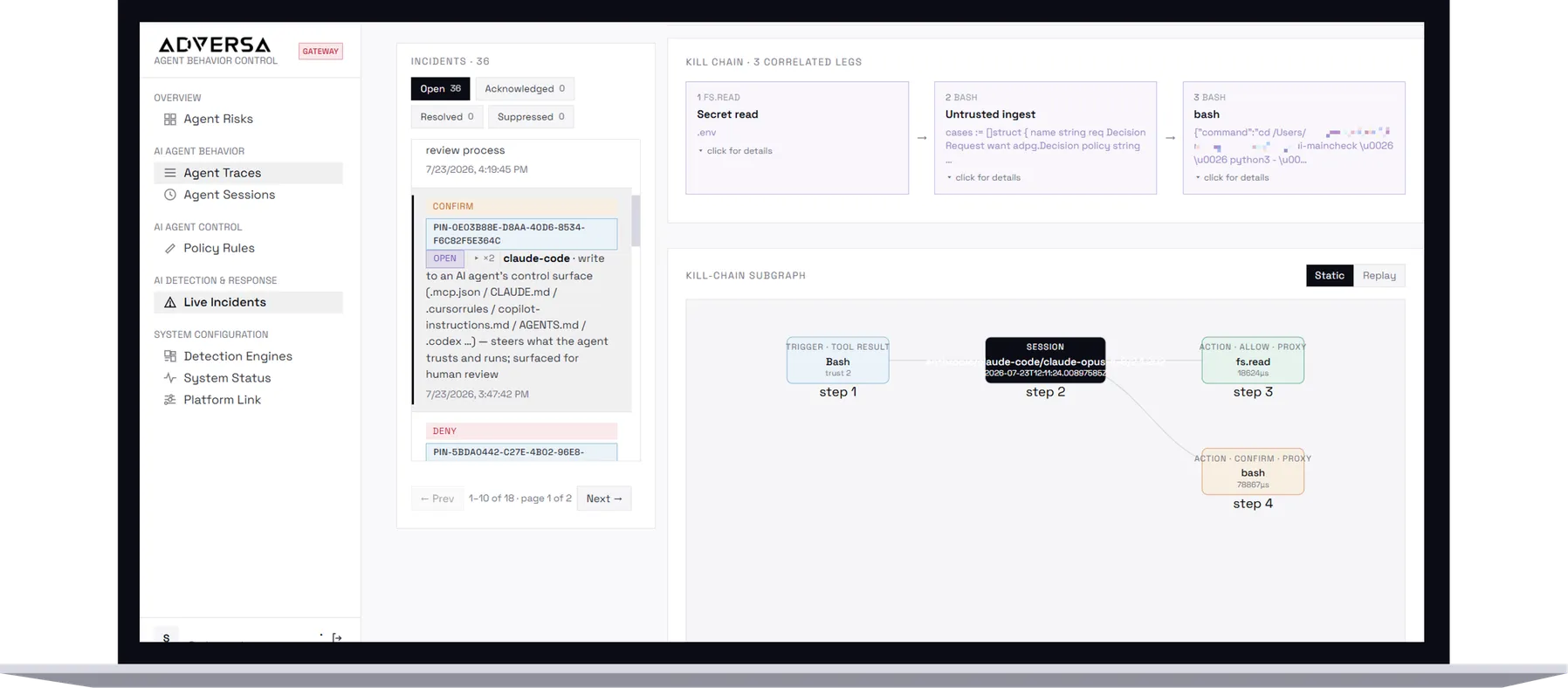
Coding agents are the one AI in your company that can change production: credentials, CI/CD, pull requests, shell. Adversa AI records what Claude Code, Copilot, Cursor, and Codex actually do and stops the dangerous action before it completes. You get the record an auditor will ask for, and a rollout you can sign.

The coding agent security platform live-incidents dashboard

[ Why CISOs care ]

Agents arrived as developer tooling.Now they hold production credentials.

Coding agents skipped the risk review because engineering bought them as a productivity tool. They act with the developer’s permissions, at machine speed, on systems that reach production. Nothing is on fire today, but three questions will reach your desk anyway:

  • “Who wrote this code?”

    The audit committee

    Today the honest answer is “we don’t fully know.”

  • “What did your AI do, per action?”

    The auditor

    AI-specific compliance requirements will only grow.

  • “Who owns what the agents did last week?”

    You

    Three teams point at each other.

One record answers all three, and gives the risk an owner.

[ Adversa AI decision graph ]

Individual actions look harmless.The chain is the breach.

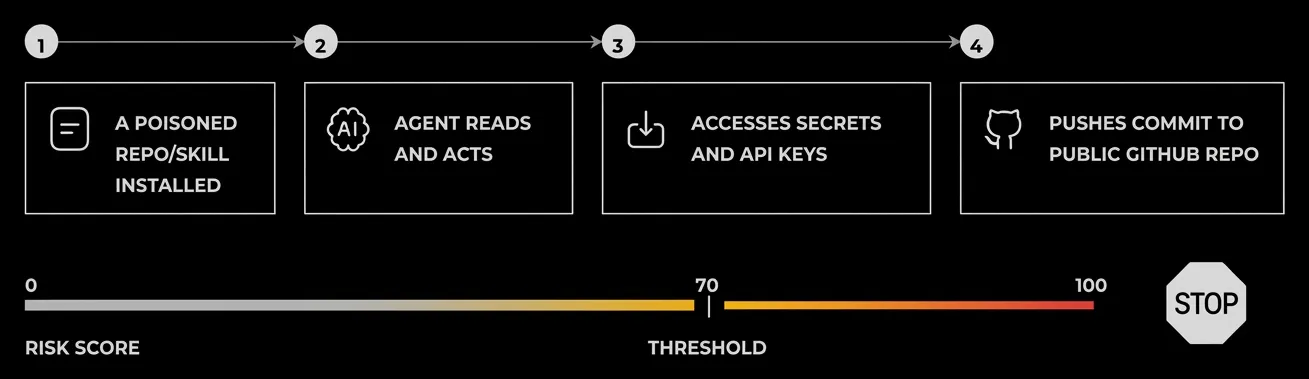
A poisoned repo or skill gets installed. The agent ingests it and starts acting on an attacker’s instructions. It reads a secret. It pushes a commit, your API keys inside. Every control you funded said yes four times: DLP saw a normal commit, EDR saw a developer’s process, the gateway saw a routine completion call. The agent was authorized for every step. The sequence was the breach, and it completed in seconds.

The platform builds an agent decision graph: every action, its inputs and its effects. Then it scores risk across the chain as it forms, across the model, the tools, and the machine. When the chain crosses the line, it’s blocked before it completes. When something does go wrong, the same chain is what you hand the auditor: what happened, what was allowed, what was blocked, by which rule.

A four-step attack chain — a poisoned repo or skill installed, the agent reads and acts, secrets and API keys accessed, a commit pushed to a public GitHub repo — scored on one risk line that crosses the threshold, and the chain stopped

[ What we stop ]

The likely incident is a mistake at scale

Cyberattacks are only one of three ways agents cause damage. The same chain analysis catches the everyday risk too.

Rogue agent behavior

[ 01 ]

“What else is the agent doing?”

What we stop: Agents gradually expanding their own scope, acting far beyond the original task, runaway loops burning compute and tokens.

Mistakes: the everyday risk

[ 02 ]

“Can one wrong command drop production?”

What we stop: A “test cleanup” that drops the production database; a quick commit carrying your secrets into public code; a key pasted into a prompt.

Attacks

[ 03 ]

“Can someone hijack your agent?”

What we stop: Prompt injection and malicious context: a poisoned repo or skill, a rogue MCP server, and the exfiltration chain each one starts.

[ Defense in depth with AIDR ]

Adds a layer your stack doesn’t have.Replaces nothing.

No single tool shows what your coding agents do across all the brands you’ve approved. This one does, and it feeds the tools you already pay for. Row by row: what each one sees, and what it structurally can’t.

What you already runWhat it seesWhat Adversa AI adds
EDR / XDRThe process. It knows an agent process wrote a file or opened a socket.The reason: the prompt-to-action chain, back to the poisoned document three steps earlier. Our verdicts land in your EDR and SOC as high-fidelity detections.
LLM proxy / AI gatewayOne request at a time, and only the traffic routed through it.Memory across the whole session, and coverage where no gateway sits: developer laptops and CI. We read from your gateway, or run as one.
SIEM / SOCEverything, afterwards. Log-based detection runs in minutes to hours; an agent’s chain completes in seconds.The inline decision point. Your SIEM stays the system of record; every incident ships to it with the full chain attached.
DLPFiles and channels.Data leaving inside a prompt, a tool argument, an encoded payload, or an agent-to-agent handoff. Secrets flagged at the tool call and blocked under policy before they leave.
Firewall / NGFWDestinations.The content and intent of a call to an approved destination. The exfiltration target is usually a sanctioned SaaS endpoint or an image URL.
SAST, SCA, secret scanningThe code, once it reaches the repo.The agent’s work that ends before the commit: the secret is read and gone before any scanner runs.
IAM / identityWhat the agent may do.What it actually did, under the credentials it inherited.

That includes the agent vendors’ own controls. Each governs one agent, its own, and only through its configuration. Adversa AI watches all of your approved agents together, at runtime.

[ Coding agent security vs alternatives ]

Can you cover this with what you already own?

Partly. Each of these is worth having. None gives you one record of what every approved agent did, and none acts before the action completes.

Built-in controls from the agent vendors

One vendor, one agent, one console. Turn them on. They govern the agent that shipped them and nothing else on the machine. Your developers run three brands side by side, and the chain that matters crosses between them. Where a model router splits calls across providers, each vendor sees only its own slice of the traffic. Three consoles are not one record.

AI features from your EDR or SIEM vendor

Coming, and worth turning on when they land. They will see what they already collect: the process on the endpoint, the log after the fact. The session and the chain are a different problem, hardest to solve on developer machines. Our verdicts land in their queues, so nothing you buy now gets ripped out later.

Your gateway and your own rules

The right infrastructure and a good start. A gateway sees one request at a time, only the traffic routed through it, and none of the tool or endpoint actions in between. The rules your platform team writes are a backlog it maintains forever, against techniques that change monthly. Keep the gateway. We read from it.

Use all three. Add the record.

Your AppSec lead will want the technical version.Coding agent security for AppSec teams

[ Platform architecture ]

How it works

Two components, one platform:

Agent security gateway


Intercepts the agents’ own traffic: LLM calls, responses, tool executions, and MCP calls. Inline, or reading from the LLM/API gateway you already run.

Endpoint security sensor


Watches actions on the machine: files, shell, CI/CD. Strictly the agent’s actions, not the developer’s.

Yes, the sensor is one more agent on the endpoint. What it costs: it sits beside your EDR, sees only the agent’s actions, adds under a millisecond to a typical check, and fails open. If it breaks, nothing blocks a developer. The gateway reads from the one you already run. Both feed one policy engine; the chain is scored as a whole; response is warn, deny, or human-in-the-loop. Cloud or on-prem.

What we break in the lab, the runtime blocks by default.

[ Compliance ]

Built for what regulators want now

Regulators moved from “show me your AI policy” to “prove, per action, what your AI did, and that you could stop it”.

EU AI Act, Art. 12

  • Required now — automatic recording of AI actions across their lifecycle.
  • What you get — a record of every action and the rule that allowed or blocked it.

EU AI Act, Art. 14

  • Required now — a human must be able to intervene and stop.
  • What you get — pre-execution blocking is that intervention, not an after-the-fact alert.

DORA

  • Required now — fast incident reporting; agents may count as third-party ICT.
  • What you get — a complete event chain to classify and report inside the reporting window.

SR 11-7

  • Required now — ongoing monitoring of production models.
  • What you get — a continuous, queryable record of model-driven actions.

Expected by auditors and counterparties

NIST AI RMF, ISO 42001, SOC 2, Japan’s AI Guidelines for Business, Singapore’s Model AI Governance Framework and MAS FEAT. They converge on the same demands: continuous monitoring, traceability, and a human in control. Mapped, evidenced, exportable in minutes.

[ Policies ]

Protected on day one,no rule-writing required

100+ attack-anchored policies ship by default

Our red team maintains the rulebook, built on years of breaking AI systems. You start covered, without writing a thing.

Your policies in plain English

Say “these developers’ agents can’t touch AWS”. The platform turns the sentence into a precise, enforceable policy — and it can turn a screenshot of an AI incident into one, too. Generated policies are validated, simulated, versioned, and approved before they go live.

Stable by design

Detecting malicious inputs purely by their wording is brittle: adversaries iterate faster than rules, and natural language has infinite surface area. We use content as one signal alongside trust state, action type, identity, and provenance, and match the shape of dangerous behavior. An agent is only as trusted as the riskiest thing it just touched: read an outside web page, ticket, or dependency, and it loses the right to open your secrets or call out to the internet — automatically. A reworded attack trips the same rule. Policies you write today still hold against attacks invented next year.

[ Trust & Proof ]

The team your auditors already cite

Adversa AI experts are co-leads and core members of industry-defining frameworks and initiatives: NIST AI RMF, OWASP ASI, CoSAI, CSA AI CM. Trusted by Fortune 500 enterprises including top banks, insurance companies, fintech, Big Four, and automotive enterprises.

Analyst recognition

Standards leadership

A decade of adversarial research

20+ industry awards

20+ industry awards

[ See it yourself ]

See what your coding agentsdid this week

One team, the agents you’ve approved, observe mode: nothing blocked, everything recorded. You get the would-have-blocked list with its false positive rate on your own traffic, and the record. Sign the wider rollout on that, not on our promise.

Form not loading? Open it in a new tab.

Frequently asked questions

Why not wait until the agent vendors ship this themselves?

They ship for their own agent, and their incentive is adoption. Whichever vendor ships controls, it won’t govern its competitors’ agents on the same machine, and your teams already run more than one. Even a single agent brand no longer means a single model: model routers split calls across providers, the complex work to one model, the cheap work to another. A provider can only secure the traffic it sees, and after routing, none of them sees it all. Cross-brand coverage with one policy surface and one record is the job.

Our EDR or SIEM vendor says AI detection features are coming. Why not wait for them?

They will ship a layer, and it will see their own telemetry first. Coding agents on endpoints are the hardest coverage problem in the category, and the agents already run with production credentials today. The layer is additive, so nothing bought now has to be ripped out later. Monitoring now, blocking on your highest-privilege agents: that interim position is exactly what the pilot delivers.

We haven’t had an agent incident. Why now?

Because it ranks low by urgency and first by blast radius, and that gap is the risk. The clearest real-world loss in this class needed no attacker: an agent deleted a production database against an explicit freeze order. Mistakes, not attacks, are the common case. And the baseline value is unconditional: a record of what your agents actually do, which you need for audit whether or not anything goes wrong.

What happens when it breaks?

Nothing blocks a developer: the design fails open. Typical checks add under a millisecond, the heaviest paths under 50 milliseconds (internal tests, July 2026, re-measured in every pilot). When it works, response is graduated: policies warn before they block, high-impact actions can require a human in the loop, and blocking is scoped per policy, per environment, per team. Observe mode shows the would-have-blocked list and its false positive rate on your own traffic before anything is enforced.

Engineering wants 2,000 seats. What do I need before I sign?

Coverage across the fleet you’re approving, an observe-mode pilot on one team, the would-have-blocked list with its false positive rate, and the record. Sign with those as conditions.

Who should own this?

Security owns the control. The record gives each team its piece: AppSec writes policy, platform runs the rollout, the SOC gets alerts with the chain attached. The pilot names the owner on day one.

What ends up in our telemetry?

Action telemetry, not your codebase. Secrets are never stored; what we ingest is documented in the trust pack; when we read from your gateway, you control what we receive. Cloud or on-prem, per customer.

Do you find agents we don’t know about?

We observe and control the agents you’ve sanctioned and routed. Coverage reporting shows which approved agents are enrolled and where the gaps are. We don’t lead with discovery claims.

Who gets the alerts, and how does this fit our SOC?

Alert routing is agreed at scoping: SOC queue, chat channel, severity thresholds. The platform feeds your SIEM, and every alert arrives evidence-backed: the chain, the rule, the matched evidence.

The board asks who wrote this code. What do we say?

Which agent, in which session, under which credentials, and what it changed, plus what was blocked. Coverage reporting shows which approved agents are in the record and where the gaps are.

Which coding agents are covered?

The agents you’ve approved — Claude Code, Copilot, Cursor, Codex, and what comes next. Policies hold when developers switch tools.

Does this replace our LLM gateway?

No. Your gateway keeps routing; we read from it selectively and add the layers it can’t see: tool executions, endpoint actions, and chain-level analysis with enforcement. No gateway yet? The agent security gateway runs as one.

Can we run it without blocking anything at first?

Yes — pilots start in observe mode: watch, log, and review the would-have-blocked list with its false positive rate on your own traffic. When you turn enforcement on, policies can warn before they block, or require a human in the loop. Blocking is per policy, when you decide.

What does a pilot look like?

14–30 days, one dev team, observe mode only, success criteria agreed in writing before the start — including measured overhead on your own traffic and the would-have-blocked list that justifies turning blocking on.

Can we use the records for audit?

Yes. Every action is recorded and export-ready for audit.