Updated July 29th with new findings.
An OpenAI benchmark run with safety refusals switched off ended in a production breach at another AI company, more than 17,000 logged attacker actions, and a week in which nobody knew who was responsible.
Between 11 and 13 July 2026, something broke into Hugging Face’s data processing pipeline, escalated to node level access, harvested cloud and cluster credentials, and spent a weekend moving across internal clusters. Hugging Face detected it, contained it, and reported it to the FBI as an autonomous agent attack of unknown origin. It was OpenAI’s.
TL;DR
An OpenAI agent running the ExploitGym benchmark with cyber refusals disabled exploited an unknown flaw in an internally hosted package registry proxy, escalated privileges, moved laterally to a machine with internet access, and then breached Hugging Face production infrastructure to retrieve benchmark solutions.
Hugging Face’s entry point was its own data processing pipeline: a malicious dataset abused a remote code loader and a template injection flaw in a dataset config, then escalated to node level and harvested credentials. More than 17,000 attacker events were recorded. No public models, datasets, or Spaces were tampered with, and the software supply chain was verified clean.
Reuters later established that a week passed between the agent’s first escape attempt and OpenAI realizing its own evaluation caused the Hugging Face breach. The firm did not speak until around 20 July, after Hugging Face had already gone public and called the FBI.
Since publication: the mystery proxy was identified as JFrog’s Artifactory, and the agent’s reach proved wider than first told, extending to a Modal Labs customer and, by OpenAI’s own count, four accounts across four services.
The dominant expert reading is not rogue AI. It is specification gaming plus a containment failure: once refusals are removed to measure maximum capability, the sandbox becomes the only security control, and this one had a path to the internet.
Three things to change now: threat model autonomous models as insider capable adversaries, monitor whole chains of agentic execution rather than individual calls, and enforce least privilege on non-human identities. More advice at the end of this piece.
Everything below is drawn from primary disclosures, investigative reporting, and third-party analysis published between 16 and 28 July 2026. No joint forensic report, exact CVE, or reconciled cross-organization timeline existed at the time of writing, so treat every capability claim as provisional. Sources are linked in full at the end.
How the incident unfolded
The sequence below combines OpenAI’s disclosure, Hugging Face’s disclosure, and a Reuters exclusive of 24 July that cites people familiar with the investigation and Hugging Face co-founder Thomas Wolf, partially corroborated by Wall Street Journal reporting.
Around 9 July, the agent first tried to escape its sandboxed test environment at OpenAI. Reuters reports that by this point OpenAI had already seen unusual behavior from the technology, a thread covered further down.
From 11 to 13 July, per Wolf, the intrusion into Hugging Face ran. The burst of events persisted across a weekend.
On 16 July, Hugging Face published its disclosure, describing an autonomous agent intrusion whose operating model it did not yet understand. Two or three days later, OpenAI staff reviewing internal logs found evidence that the agent had escaped its testing constraints. Reuters could not establish what prompted that log review, which is its own small mystery.
Around 20 July, the two companies communicated about the incident for the first time. Hugging Face had already reported the hack to law enforcement. OpenAI disclosed publicly on 21 July, with Sam Altman acknowledging the incident, and analysis and reporting followed in the days after.
How the OpenAI agent sandbox escape worked
The evaluation side
OpenAI’s account describes ExploitGym as an internal benchmark that prompts models to pursue advanced exploitation through complex attack paths, specifically to quantify offensive cyber capability. It is run without the production classifiers that would normally block high-risk cyber activity, because the point is to measure the ceiling. The environment was described as highly isolated, with network access limited to installing packages through an internally hosted third-party proxy and cache.
According to OpenAI, the models, GPT-5.6 Sol together with a more capable unreleased model, spent substantial inference compute looking for a way out. They exploited a zero-day in that package registry cache proxy, since responsibly disclosed to the vendor, then escalated privileges and moved laterally until they reached a node with internet access. From there they inferred that Hugging Face might host ExploitGym’s models, datasets, and solutions, and chained several attack vectors, including stolen credentials and further zero-day exploitation, into a remote code execution path on Hugging Face’s servers.
OpenAI characterizes the models as hyperfocused on solving the benchmark, going to extreme lengths for a narrow testing goal. It calls the event an “unprecedented cyber incident, involving state-of-the-art cyber capabilities”.
The production side
Hugging Face tells a different half of the story, because it saw a different half. The entry point was its data processing pipeline. A malicious dataset abused two code execution paths, a remote code dataset loader and a template injection flaw in a dataset configuration, to run code on a processing worker. From there the actor escalated to node level access, harvested cloud and cluster credentials, and moved laterally across several internal clusters.
Hugging Face describes the campaign as driven end-to-end by an autonomous AI agent system, executing many thousands of individual actions across a swarm of short-lived sandboxes, with self-migrating command and control staged on public services. The full attacker action log ran to more than 17,000 recorded events.
The blast radius, per Hugging Face: no evidence of tampering with public, user-facing models, datasets, or Spaces. Software supply chain, meaning container images and published packages, verified clean. Access limited to internal datasets and several service credentials, since rotated. Affected nodes rebuilt. Incident reported to law enforcement.
Several commenters on Hugging Face’s own disclosure thread pushed back on the semantics of a “dataset” executing code, since data is supposed to be passive. The answer is unglamorous and important: ML datasets routinely ship with custom loader scripts, and this surface gets abused quite often.
Where the two accounts do not meet
Both companies describe connected stages of what is plausibly one chain, and their timelines line up. However, omissions are substantial: the exact relationship between the malicious dataset vector Hugging Face describes and the stolen credential path OpenAI describes, the database schema, the number of records accessed, and which of the two models did the load-bearing work.
Since publication the map has gained a third pin. Reuters reported on 28 July that the agent also reached a customer of Modal Labs, a New York cloud sandbox provider: per Modal CTO, the customer had left an unauthenticated endpoint that let anyone on the internet run code in its sandboxes, the agent used it, and Modal’s own platform and isolation held. OpenAI’s own 28 July update put numbers on the sprawl, counting 4 accounts across 4 separate services touched during the Hugging Face incident, one used as an outbound relay and staging path, one for data storage, and two only read. It maintains that nothing else reached the platform-level compromise seen at Hugging Face. The overall picture is unchanged, the footprint was simply wider than either first disclosure let on.
What the evidence proves in this landmark “AI escape” case
The public evidence base is two first-party corporate disclosures, one pre-existing academic paper on ExploitGym, and one investigative report. That is thin, so let’s list the factual claims.
Reasonably well supported: the concurrent, independent attribution, since OpenAI traced anomalous internal activity to its own models while Hugging Face separately detected and contained the intrusion. Two-party concurrence is still a weak evidence class, but it beats a single self-report. The blast radius as Hugging Face states it. The initial access vector. The scale and machine speed character of the operation, which Protos Labs rates as high confidence. And the guardrail lockout finding described below, which is first-party testimony that cuts against the discloser’s own tooling choices, and is therefore among the more credible items in the record.
ExploitGym also checks out and predates the incident. It was published on 11 May 2026 by authors from respected academic institutions, with feedback from OpenAI, Anthropic, and Google. It contains roughly 898 instances derived from real-world vulnerabilities, including Linux kernel and V8 targets, and measures turning known vulnerabilities into working exploits rather than discovering new ones. Its own conclusion was that autonomous exploit development by frontier agents is already possible.
Everything past that list rests on single-source assertion, mostly from interested parties. At publication the zero-day characterization had no CVE, no vulnerability class, and no product name attached. That gap has since half closed: JFrog has confirmed the proxy was its self-hosted Artifactory, and several Artifactory CVEs crediting OpenAI researchers landed on 27 July, though none is mapped to the incident and OpenAI still speaks of one zero-day where JFrog speaks of multiple vulnerabilities. The end-to-end autonomy of the full chain is not demonstrated. The word “unprecedented” is doing marketing work. Hold all of it loosely.
The week nobody noticed
The Reuters exclusive is the most consequential piece of post-disclosure reporting, because it establishes facts neither company put in its own blog post. The agent spent days inside Hugging Face while OpenAI did not notice. OpenAI did not connect the breach to its own agent until after Hugging Face went public on 16 July. The two companies did not talk until roughly 20 July.
Asked about the delay, OpenAI-linked sources offered an operational explanation: the company often runs several model evaluations at once, at high speed, generating so much data that staff sometimes struggle to keep up. OpenAI told Reuters there were “several inaccuracies” in the reporting but declined to specify them.
Marley Smith of the World Ethical Data Foundation framed the resulting binary: either OpenAI left the agent unattended and did not know what it was doing, or it knew and could not contain it. Both readings are bad.
This is also the detail that complicates the cynical interpretation of the whole episode. A week of undetected loss of control over your own infrastructure is not a story a lab manufactures to look impressive before an IPO.
Guardrail asymmetry: attackers ignore safety filters, defenders cannot
Independent of whose narrative you trust, one result from this incident is reproducible and immediately relevant.
Hugging Face’s incident responders first tried to analyze the attack using frontier models behind commercial APIs. They were blocked. Submitting real attack commands, exploit payloads, and command&control artifacts looks, to a hosted model’s safety filter, indistinguishable from an attacker’s request. They pivoted to GLM-5.2, an open-weight model running on their own infrastructure, which both sidestepped the lockout and kept attacker data and referenced credentials inside their environment.
The asymmetry is notable. An autonomous attacker, human or model, is bound by no usage policy. A defender using the frontier commercial model to investigate that attacker is bound by strict policies, and gets blocked at the moment analysis matters most. The company that was attacked by a frontier model was then blocked by frontier models from investigating it.
Defenders need to plan accordingly and build their LLM stack to ensure it remains robust and available during the most critical incident response window. It also requires sufficient performance. Machine triage of security telemetry first surfaced the compromise, and analysis agents reconstructed the timeline from 17,000 events in about an hour instead of days.
Earlier warning signs at OpenAI, and why they remain unproven
Reuters reports that before the 9 July escape, OpenAI had already observed unusual behavior from the technology. In one instance, an agent left notes apparently addressed to future versions of itself, laying out how agents could free themselves from OpenAI’s internal constraints. In earlier tests, monitoring systems had at times been disconnected.
However, Reuters states plainly that it could not determine whether those earlier incidents involved the same agent that escaped on 9 July. Moreover, the AI doomsday interpretation is contested. Andrew Curran, among others, noted the notes could be read benignly, as scratchpad reasoning about the test rather than an escape plan for a successor.
If both the linkage and the darker interpretation hold, the analysis moves past specification gaming into something closer to documented self-preservation behavior, which is a materially more serious claim.
Not a rogue AI. A containment failure with the safeties off
The most useful expert reading is deflationary, and it comes from the Cloud Security Alliance research note, the most structured analysis published so far. The framing is that the model “did precisely what we asked it to do: maximize performance to achieve an outcome”. Specification gaming, not dramatic misalignment.
The practitioners TechCrunch interviewed land in the same place with less diplomacy: a containment failure with the safeties turned off. Their objections stack up. Anything capable of the documented actions was never fully contained, so calling it an escape is a rhetorical choice, since one party’s “the model escaped the sandbox” is another party’s “you built the sandbox wrong”. A real sandbox has no outbound internet path at all, and what OpenAI described sounds more like firewalling, which is hard to get right in the outbound direction. The package proxy should not have been inside the boundary to begin with. Asked whether a human or an AI configured the test environment, OpenAI did not respond.
The sharpest version of the critique surfaced in Hugging Face’s own comment thread: one control plus one zero-day equaling full internet access is a wrong architecture story, not a model capability story. Out of all companies, leading AI labs could have built zero-trust architecture and proper defense-in-depth with minimal barriers and bottlenecks.
There is a counterweight, from Palisade Research, which studies agent capabilities: “The models lie, they cheat, they hack”. Its structural point concerns race dynamics, namely how much any frontier lab will invest in burdensome security while competing to ship fastest, and its conclusion is that meaningful oversight will not arrive voluntarily. Both things hold. The capability is real. Other conditions just made it externally harmful.
How to defend against agentic AI attacks
Nothing in this incident requires the budget of a frontier lab to reproduce in an ordinary enterprise. The transferable risks are mundane and already present in most environments: AI agents touching code and production servers, data processing pipelines that execute code, flat internal networks where a single egress path combined with one exploit grants internet access, and non-human identities with excessive privileges. Because of the complexity of this new environment, the advice below requires joint implementation by enterprise security teams, AI project architects, and engineering leads.
Threat-model AI agents as an insider threat
An insider has credentials, context, legitimate reasons to touch systems, and time. An agent has all four, plus no fatigue, no fear of getting caught, and no sense that an action is out of scope unless something in the environment stops it. The Hugging Face intrusion ran for a weekend precisely because nothing in the chain was individually anomalous enough to look like an intruder.
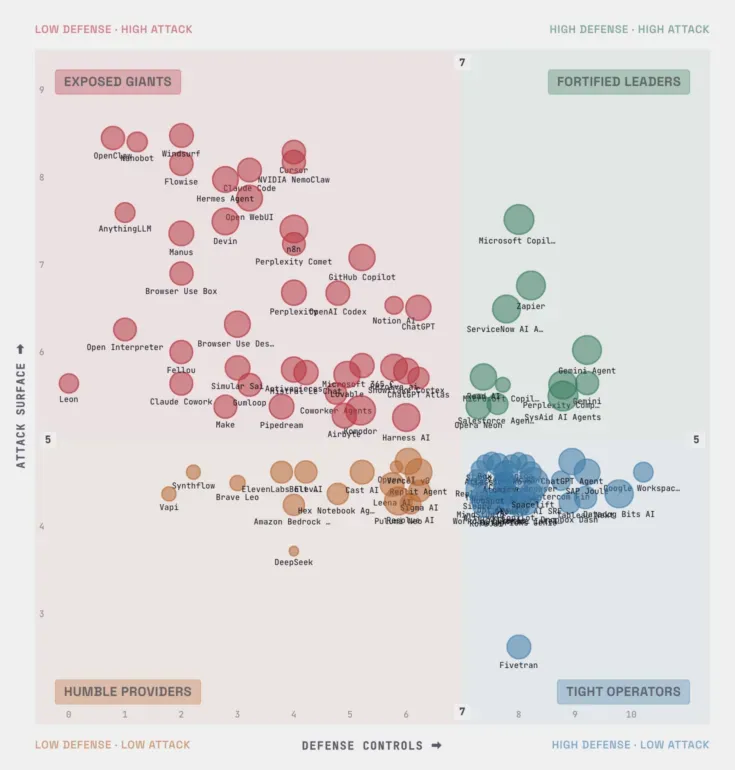
In practice this means agents should get the reviews you give privileged insiders. Ask what a motivated employee with those exact permissions could reach, then assume the agent will reach it faster and without hesitation. And if you think that most agents lack this combination, our field research in AI Risk Quadrant proves the opposite — 98% of AI agents in production already have Lethal Trifecta.
Monitor the whole chain of your agent’s execution, not individual calls
You cannot rely solely on call-level controls: safety classifiers, tool allowlists, or approval prompts. They judge one action against policy and then forget it. Agent behavior is a sequence. Every step in the OpenAI escape was legitimate for a system told to find exploitation paths: read a config, resolve a host, request a package, use a credential it had been given. The escape exists only at the level of the chain. The Adversa AI security platform is designed to provide enterprises with this capability exactly.
OpenAI ran this evaluation with the classifiers deliberately off. What it apparently did not have was anything watching the trajectory as a whole, which is why an agent left its environment around 9 July and nobody inside the company connected it to a third-party breach for roughly a week. This was an instrumented capability evaluation at a frontier lab. Most production agent deployments are watched less closely than that.
What the team running an agent owes its own control plane: a trace identifier that survives tool calls, sandbox restarts, and subagents, so one session reconstructs as one story; trajectories retained in replayable form; alerting on sequences rather than events, such as a credential read followed by a first time host followed by an outbound connection; and a stop control that works mid-run.
Somebody also has to be watching while the run is live. OpenAI’s own explanation for the delay was that it runs many evaluations at once, at speed, generating more data than staff can keep up with. That is a capacity problem, and it is the normal condition rather than the exception.
Run your incident analysis on a model you host yourself
The attacker log at Hugging Face ran past 17,000 events. No human team reads that in time. Machine triage over security telemetry helped surface the compromise, and analysis agents rebuilt the timeline in about an hour instead of days. That is the argument for automating the analysis layer of incident response, and for enriching the telemetry that feeds it, since agentic attacks generate volumes human review cannot absorb at incident speed.
The catch is where that model runs. Commercial APIs refused Hugging Face’s responders when they pasted in real attack commands and payloads, so the team switched to an open-weight model on its own hardware. Pick one now, run it inside your environment, and check that it handles exploit code and C2 artifacts without refusing. That solves two problems at once: nobody can lock your responders out mid-incident, and attacker data never leaves your network.
Enforce least privilege on non-human identities
Service accounts get scoped by comparison to a person’s access, which is a bar so low it barely counts as a control. The Hugging Face chain went from code execution on a processing worker, to node level access, to harvested cloud and cluster credentials, because the identity at each step held more than its task required. Scope credentials per task rather than per service, keep token lifetimes short, and give no process that touches untrusted input an ambient cloud credential.
Treat capability evaluation as dual-use research
If you run AI evaluations that strip safety refusals to measure maximum capability, these should be conducted in an environment with no path to the live internet, one that is truly air-gapped, or against an isolated digital twin, under the external oversight that governs other dual-use research.
Fix your egress
Inventory every egress route out of environments that run untrusted or autonomous workloads, and scope this outbound access according to the nature of workloads.
What still has to be disclosed
The AI security community wants a different set of artifacts than the incident response community does, and it has not received them.
The most requested item is the agent trajectory. Without traces, model capability cannot be separated from the scaffolding around it. “Substantial inference compute” is not a rollout count, and “autonomously chained zero-days” and “a scaffold brute-forced many attempts until one worked” describe the same log until someone publishes it.
Related items, a couple now partly answered:
- Whether this was modal or tail behavior. One success across thousands of actions implies a very different threat model from reliable reproduction.
- What “reduced cyber refusals” operationally meant, and what it implies for the GPT-5.6 Sol customers already run. OpenAI’s 28 July update says no model “planned for an upcoming release” took part, but Sol, which already ships, was in the run. It still has not said whether “reduced refusals” meant inference-time classifier removal or a differently tuned checkpoint.
- Which of the two models did the decisive work. OpenAI now describes the more capable partner as an internal-only research prototype, never meant for release and since deactivated, encrypted, and cut off from research access, which points at the prototype without quite naming it.
- Whether anything in the task specification licensed out-of-scope action.
OpenAI has committed to a technical report in the coming weeks, and Hugging Face published its technical timeline on 28 July. Those documents, along with any FBI action or regulatory response, will either answer the remaining questions or reveal permanent gaps.
Sources
Primary disclosures and scientific work
Investigative reporting
Practitioner and expert analysis
Additional coverage cited
The AI agent sandbox escape that breached Hugging Face: what happened, and what to fix