Prompt injection remains one of the most dangerous and poorly understood threats in AI security. To assess how today’s large language models (LLMs) handle Prompt Injection risks, we interviewed ChatGPT, Claude, Grok, and Deepseek. We asked each of them 11 expert-level questions covering real-world attacks, defense strategies, and future readiness.
Prompt Injection Risks: Key Findings from the Interviews
- All four chatbots agree: prompt injection risks are serious, evolving, and won’t be “solved” in the next few years.
- As a result, defense must be multi-layered, combining input validation, output filtering, adversarial testing, and user education.
- Blind spots exist, especially around multimodal attacks, memory leakage, and supply chain threats.
- External AI red teaming and continuous model evaluation are essential for LLM security going forward.
Read on for a full comparison, surprising insights, and what these models can teach us about securing AI systems in real-world deployments.
Methodology: How the Interview Was Conducted
To explore the current understanding of prompt injection risks, we developed 11 expert-level questions. They addressed case studies, mitigation tactics, future challenges, multimodal attacks, and the importance of collaboration across teams. Each question was crafted to ensure clarity and allow consistent comparison across responses.
We interviewed ChatGPT (OpenAI), Claude (Anthropic), Grok (xAI), and Deepseek (DeepSeek) in separate sessions. They didn’t have access to each other’s answers. We also used identical phrasing throughout to ensure consistency.
This setup allowed us to treat them as panelists in a virtual roundtable. On a technical level, some responses focused on practical techniques like input sanitization or anomaly detection. In contrast, others emphasized governance, training, and long-term resilience. Despite these differences, all agreed: prompt injection is still an open problem, and meaningful progress may take another 5–10 years.
After collecting the responses, we manually analyzed the results. The team grouped key insights, identified blind spots, and looked for shared themes. We preserved the original meaning when quoting or summarizing model responses. Taken together, the answers reveal how leading language models perceive one of AI’s most urgent security threats. They also offer insights into how we can defend against it more effectively.
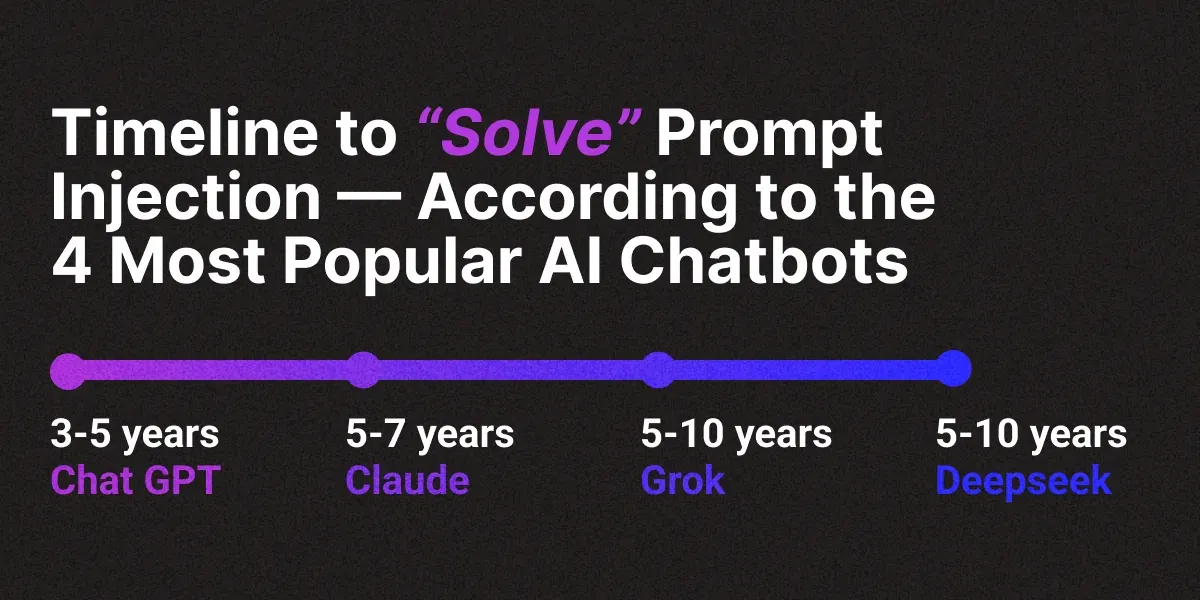
ChatGPT, Claude, Grok, and Deepseek predict different timelines to solve prompt injection risks—from 3 to 10 years
Interview Questions: How We Challenged the AI Chatbots on Prompt Injection
We asked 11 expert-level questions to reveal how today’s top language models think about prompt injection threats. These questions explore real-world exploits, defenses, multimodal risks, and the role of red teaming, education, and policy in AI security.
- What are some of the most significant prompt injection attacks you’ve encountered? What were the targeted use-cases? What lessons were learned from these incidents across different teams?
- Could you share any case studies of prompt injection attacks and their consequences across various industry sectors?
- How can organizations assess their vulnerability to prompt injection attacks? Be technical.
- Is system prompt fine-tuning an effective mitigation strategy?
- In your opinion, what are the most effective methods right now for protecting AI applications from prompt injection? Let’s dive into the details.
- How can we deal with false positives when implementing defenses?
- Are we prepared for multimodal prompt injection attacks (e.g., images, audio, code + text)?
- Beyond existing guardrails, what emerging technologies or methodologies show promise for defending against prompt injection?
- What kind of collaboration between AI developers, security experts, and policymakers is needed to build resilience against prompt injection?
- What are the challenges in educating end-users (or prompt engineers) about indirect prompt injection attacks and their downstream impact?
- Looking into the future — when do you think we’ll reach a point where prompt injection is “solved”, perhaps similar to how SQL injection is handled today?
What the AIs Agree On: Common Ground Across 4 Chatbots
Despite differences in training and alignment, all four models identified similar core principles in mitigating prompt injection threats. Collectively, they see this threat as serious, unsolved, and growing in complexity. As a result, each one emphasized that single-layer defenses like prompt tuning are insufficient and advocated for layered security strategies that include input filtering, output validation, and continuous monitoring.
Furthermore, all models recognize that the solution is not purely technical. In their view, education, policy, and collaboration between stakeholders are equally important for ensuring long-term resilience.
Where AI Chatbots Agree on Prompt Injection Defense
| Question | Shared Answer Across AIs | Example Quote |
|---|
| Is system prompt tuning effective? | It’s helpful, but not enough. | Claude: “Limited first line of defense… insufficient as standalone.” ChatGPT: “Not sufficient alone… use with input validation.” |
| Timeline to “solve” prompt injection | 5–10 years | Deepseek: “Widespread resilience may take 5–10 years.” Grok: “Manageable within the next 5–10 years.” |
| Most effective protection today | Input sanitization + monitoring + output filtering | ChatGPT: “Input validation, response filters, structured formats.” Grok: “Input sanitization… runtime monitoring.” |
| View on education | User awareness is key | Claude: “Abstract nature… hard to visualize.” Deepseek: “Users trust AI blindly… explain with demos.” |
This shared understanding reflects a maturing awareness within the AI ecosystem—but also shows how early the field still is in terms of operational solutions.
Where They Differ: Key Contrasts in AI Perspectives
To understand how today’s leading large language models (LLMs) approach prompt injection threats, we crafted 11 expert-level questions. These questions highlight real-world attack scenarios, mitigation techniques, risks in multimodal systems, and the role of red teaming and education. Each one aims to uncover both the technical strengths and the blind spots in AI security and alignment strategies.
Key Differences in How AI Chatbots Approach Prompt Injection
| Topic | Chatbot | Unique Focus | Example |
|---|
| Tooling and AI red teaming | Deepseek | Named specific tools (e.g., Garak, PromptInject) | “Use LM-based attack simulators like Garak…” |
| Governance and collaboration | Claude | Focused on regulation and shared taxonomies | “Developers must work with policymakers… create shared repositories.” |
| Practicality and real-world scenarios | Grok | Frequent industry case studies (finance, healthcare) | “Chatbots leaked transaction info… raised regulatory concerns.” |
| Technical specificity | ChatGPT | Prioritized structured inputs and token isolation | “Structured formats and separate token channels reduce attack surface.” |
These contrasts make it clear: while there is no single way to approach prompt injection defense, combining these viewpoints gives us a fuller picture. A robust AI security strategy should borrow from all these schools of thought—technical depth, offensive testing, user education, and governance.
To summarize these differences, the table below compares how each AI Chatbot describes prompt injection risks, defense strategies, and priorities. This comparison offers a clear view of the strengths, biases, and blind spots across systems—and provides a helpful reference for teams designing secure AI applications.
Side-by-Side Comparison: Prompt Injection Defenses by AI Chatbot
| Aspect | ChatGPT | Claude | Grok | Deepseek |
|---|
| Tone & Style | Concise, technical, solution-oriented | Governance-aware, ethical, long-term | Practical, focused on real-world cases | Security-driven, tool-specific |
| View on Threat Level | High — growing and unsolved | High — evolving rapidly | High — observed in industry | High — requires constant testing |
| System Prompt Tuning | Helpful but insufficient | First line, not enough | Helps, but must be combined with other tools | Limited protection — must be layered |
| Top Defense Methods | Input validation, structured inputs, response filtering | Runtime guardrails, sandboxing, anomaly detection | Input sanitization, runtime monitoring | Red teaming, adversarial training, access limitation |
| Mentioned Tools or Techniques | Token isolation, JSON schemas | Dynamic thresholds, least-privilege APIs | Runtime audits, multi-layered filters | Garak, PromptInject, formal verification |
| Multimodal Attacks | Acknowledge risk, few details | Highlighted gaps in current testing | Warns about lack of defenses | Calls out steganography, needs cross-modal testing |
| Blind Spots | No mention of plugin/API risks | No mention of memory leakage | No mention of tool-specific exploit surfaces | No clear focus on user education |
| Perspective on Education | Important for prompt engineers | Crucial — needs accessible training | Needed, but underdeveloped | Use demos to explain “AI phishing” to users |
| Governance & Policy | Not discussed in depth | Emphasized heavily — needs shared standards | Touched briefly (regulatory risk) | Suggested frameworks like MITRE ATLAS |
| Forecast to “solve” prompt injection | 3–5 years for risk reduction | 5–7 years with architecture changes | 5–10 years to become manageable | 5–10 years, depending on interpretability & standards |
Blind Spots in AI Chatbots’ Approach to Prompt Injection Risks
Despite their strengths, all four models shared a few blind spots—gaps that should concern developers and security teams alike.
For instance, none mentioned supply chain vulnerabilities, such as compromised APIs or third-party plugins introducing prompt injection vectors indirectly. Very few touched on cross-session prompt leakage, a known issue in memory-augmented agents and autonomous workflows.
AI chatbots don’t think like humans — but they all pointed to the same danger: prompt injection
Blind Spots in AI Chatbots’ Approach to Prompt Injection Risks
Despite their strengths, all four models shared a few blind spots—gaps that should concern developers and security teams alike.
For instance, none mentioned supply chain vulnerabilities, such as compromised APIs or third-party plugins introducing prompt injection vectors indirectly. Very few touched on cross-session prompt leakage, a known issue in memory-augmented agents and autonomous workflows.
Gaps in Testing Prompt Injection Risks in Multimodal and Supply Chain Scenarios
Prompt injection attacks are no longer limited to plain text. As large language models (LLMs) expand into multimodal systems—processing images, audio, and other formats—new vulnerabilities emerge. Yet most models failed to describe how to detect or test multimodal prompt injection attacks effectively.
While all four AIs acknowledged the risk, they offered no detailed methods for simulating multimodal exploits, such as hidden triggers in image captions or poisoned speech recognition inputs—leaving key areas of AI red teaming and LLM security testing underexplored.
This highlights a critical gap in current AI security practices: most defenses remain text-centric, while attackers are already targeting cross-modality vulnerabilities and AI supply chain risks. To defend real-world AI deployments, organizations must invest in dedicated tools and frameworks for multimodal prompt injection testing.
Conclusion: What This Interview Reveals About Prompt Injection Risks
This experiment—interviewing four state-of-the-art AIs—offered not just answers, but a collective map of how today’s models see and explain prompt injection risks. While they don’t “think” like humans, their responses reflect how current training, alignment, and design philosophies shape the security conversation.
Key Takeaways from the Interview
- Prompt injection is real, ongoing, and rapidly evolving. All four models confirmed it’s a major concern in AI deployment today—not a hypothetical threat.
- Mitigation requires multiple layers. Input validation, output filtering, prompt isolation, and adversarial testing are consistently recommended.
- Education and collaboration matter. Technical solutions alone won’t scale. Awareness among users, engineers, and policymakers is essential.
- No chatbot has full coverage.
Each AI had blind spots—especially around supply chain risk, multimodal injection testing, and real-time exploit detection.
- We are still early in the defense lifecycle.
Predicting a 5–10 year horizon for maturity shows how much experimentation, tooling, and standardization is still needed.
- External AI Red Teaming is critical.
As attackers grow more sophisticated, organizations must adopt independent offensive testing platforms like Adversa AI to stay ahead.
The diversity of responses from these models highlights more than just technical nuance—it reveals different security priorities embedded in each system. By comparing them side by side, developers and security leaders gain practical insight into which threats are well-understood and which remain under-explored.
To build truly secure AI applications, organizations must combine structured evaluation, independent red teaming, and cross-functional collaboration.
No single chatbot or method will fully “solve” prompt injection. However, by stress-testing today’s systems—and learning from their blind spots—we can move toward safer, more trustworthy deployments.
Subscribe for updates
Stay up to date with what is happening! Get a first look at news, noteworthy research and worst attacks on AI delivered right in your inbox.
Prompt Injection Risks Interview: Are AIs Ready to Defend Themselves? Conversation with ChatGPT, Claude, Grok & Deepseek