Adversa AIGet a demo

[ Runtime Security Platform for AI Coding Agents ]

Stop the damage,not the developers

The runtime control layer for enterprises deploying AI coding agents at scale. It sees every LLM call, tool execution, and endpoint action your agents take, connects them into chains, and blocks only the dangerous ones before they complete. Your developers keep shipping. Works across every coding agent: Cursor, Claude Code, Copilot, and what comes next.

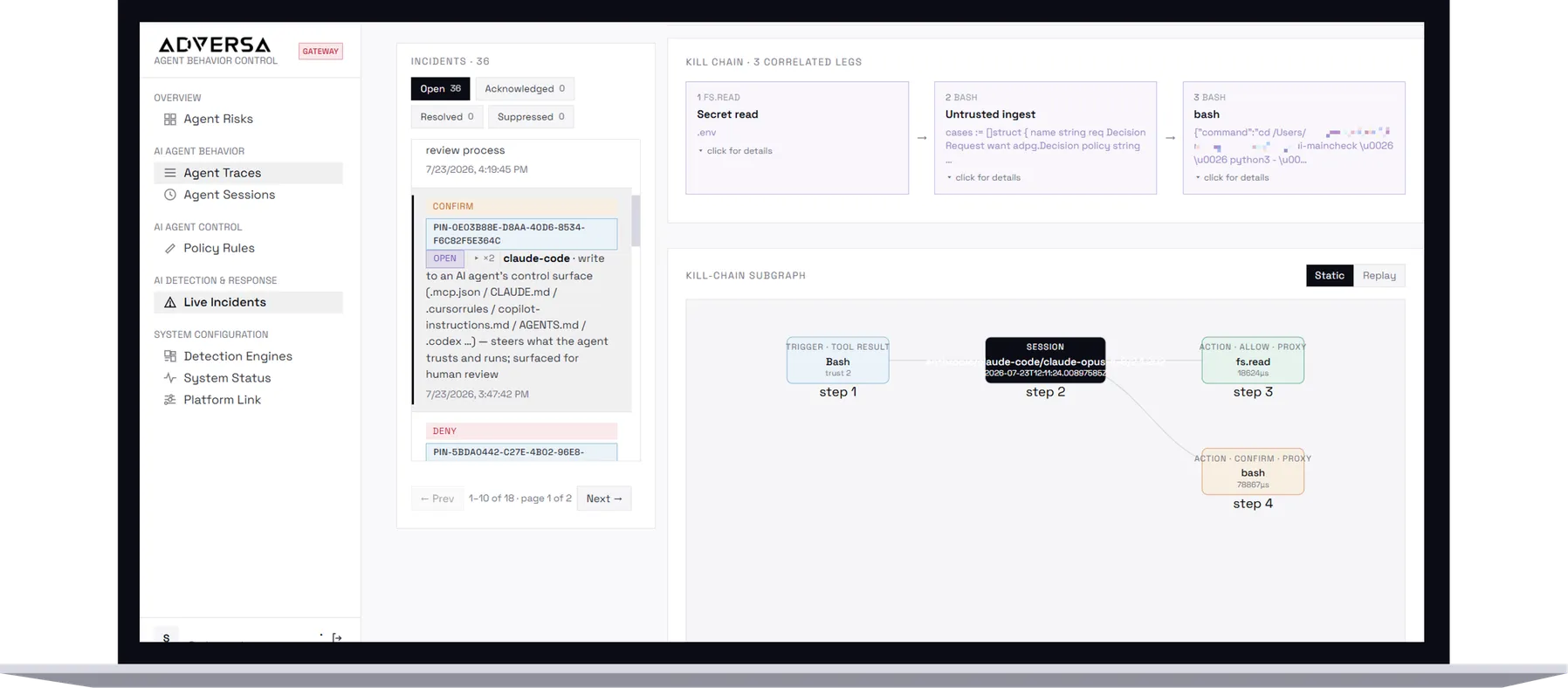
The Runtime Security Platform live-incidents dashboard

[ The stakes ]

The risk is already here

“I violated every principle I was given.”

Source: Live Science

An AI coding agentmoments after deleting a company’s production database. In nine seconds.

73%

of developers use AI coding agents daily

90%

of enterprise teams use them in the development lifecycle

Real incidents

  • Agents hijacked through prompt injection in logs
  • Secrets leaked into public code
  • A production database deleted by a hallucinating agent

Prompt injection in logs — reported by Microsoft Security

Most teams today choose between banning coding agents and crossing their fingers. There is a third option.

[ The blind spot ]

Why nothing in your stack sees this

  • AI firewalls and guardrails

    They read prompts and responses. They are blind to what the agent then does.

  • Vendor-native controls

    Copilot policies, Claude Code enterprise settings govern one vendor’s agent. Your developers run three. Policy written for one tool covers a third of your fleet — and nothing that crosses between them.

  • Identity tools and sandboxes

    They see either who is acting or what the action is. Never both together.

  • Traditional security (EDR, scanners)

    Built for predictable software, not agents that improvise. Useful rules are painful to write.

Each catches a piece. None connects who, what, and behavior into one picture. That is the gap Adversa AI closes.

[ How it works ]

Runtime security for AI coding agents

See every action your agents take. Understand it in context.Stop the dangerous ones.

See

Full visibility across every agent surface


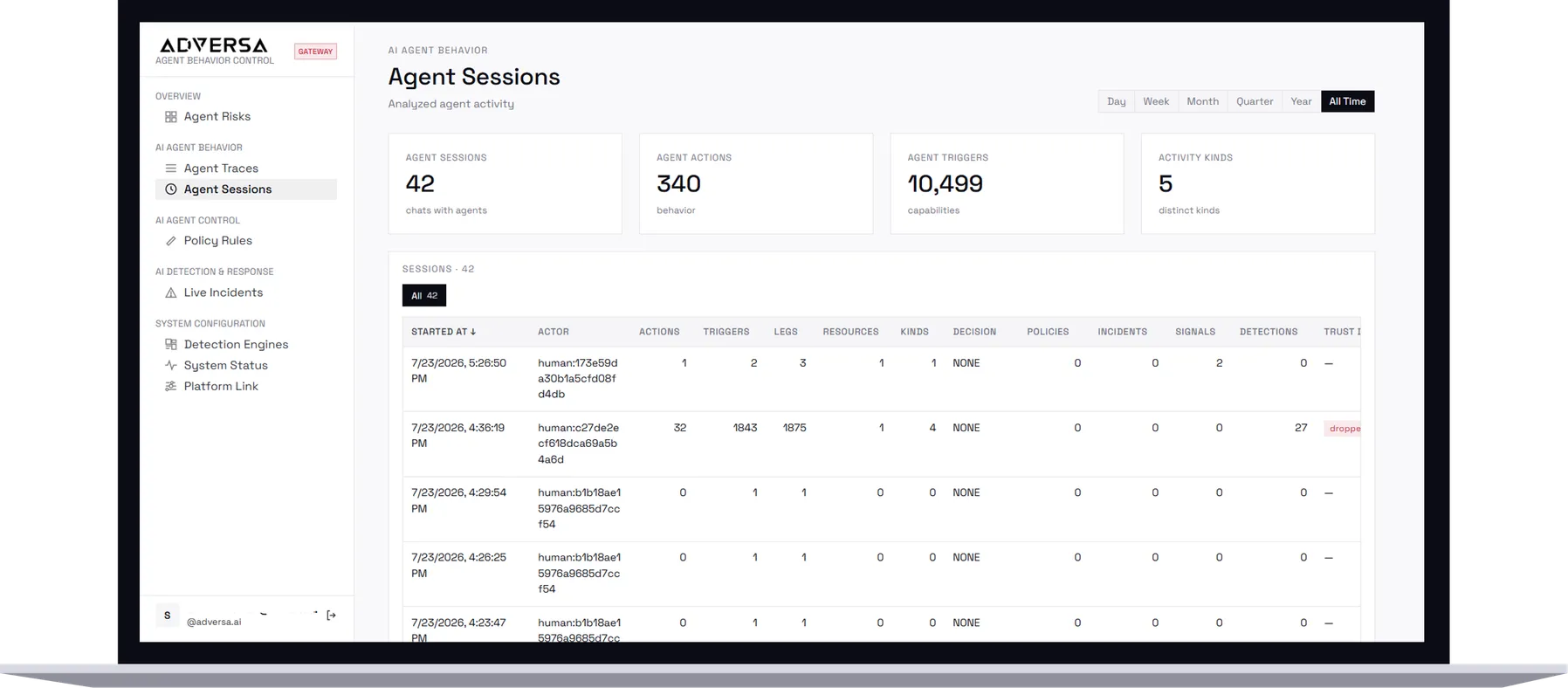
See what the coding agents you’ve approved actually do. Every model call, every tool call, every file touched, every outbound connection, attributed to the human who initiated it. Watched at three points: the AI model, the tools it uses, and the developer’s machine.

Understand

Connect the dots single events don’t show


A Jira ticket or GitHub issue hides an instruction → the agent reads it and acts → pulls and installs untrusted repositories → pushes a commit to a public repo, your API secrets inside.

Each step looks like normal dev work. The chain is the breach.

Adversa AI correlates actions across model conversations, tool calls, and developer machines into one chain, and catches multi-step patterns that look harmless one event at a time. Single-event tools wave each step through, because each step on its own is fine.

Stop

Block the chain before it completes


Rules score risk across the linked chain as it builds, not one action at a time. When the score crosses the line you set, the chain is blocked before it completes. The developer gets a clear error and keeps working. Enforcement is yours to scope: per policy, per environment, per team.

Adversa AI dashboard screenshot showing product risk and evidence views

[ Coverage ]

What we stop

  • Attacks

    Someone hijacks your agent: prompt injection in a ticket, a poisoned dependency, instructions hidden anywhere the agent reads.

  • Mistakes and dangerous commands

    The common case. “Clean up the test environment” turning into a delete on the production database. Leaked secrets. Wrong packages installed.

  • Drift

    The agent wandering past what it was ever meant to do, gradually expanding its own scope.

[ Policies ]

Protected on day one,no rule-writing required

Over 90 attack-anchored policies ship by default

Our red team maintains the rulebook, built on years of breaking AI systems. You start covered, without writing a thing.

Your policies in plain English

Say “these developers’ agents can’t touch AWS” or “no agent runs a delete in production.” The platform turns the sentence into a precise, enforceable policy.

Stable by design

Detecting malicious inputs purely by their wording is brittle: adversaries iterate faster than rules, and natural language has infinite surface area. We use content as one signal alongside trust state, action type, identity, and provenance, and match the shape of dangerous behavior. An agent is only as trusted as the riskiest thing it just touched: read an outside web page, ticket, or dependency, and it loses the right to open your secrets or call out to the internet — automatically. A reworded attack trips the same rule. Policies you write today still hold against attacks invented next year.

[ Deployment ]

How it deploys

  1. A checkpoint your agents’ actions pass through. Runs on your infrastructure or in the cloud, your choice.

  2. Lightweight agents on developer machines for full coverage. They run alongside your EDR and watch only AI activity.

  3. Start in observe mode, just watching and logging, for as long as you need. Turn on blocking when you’re ready.

  4. First signal in minutes. No code changes, no change to how developers work.

  5. One platform across Cursor, Claude Code, Copilot, and what comes next. No lock-in to any AI or harness vendor, no rebuilding policy when your developers switch tools.

[ Trust & Proof ]

Built by the teamthat breaks AI for a living

Adversa AI experts are co-leads and core members of industry-defining frameworks and initiatives: NIST AI RMF, OWASP ASI, CoSAI, CSA AI CM. Trusted by Fortune 500 enterprises including top banks, insurance companies, fintech, Big Four, and automotive enterprises.

Analyst recognition

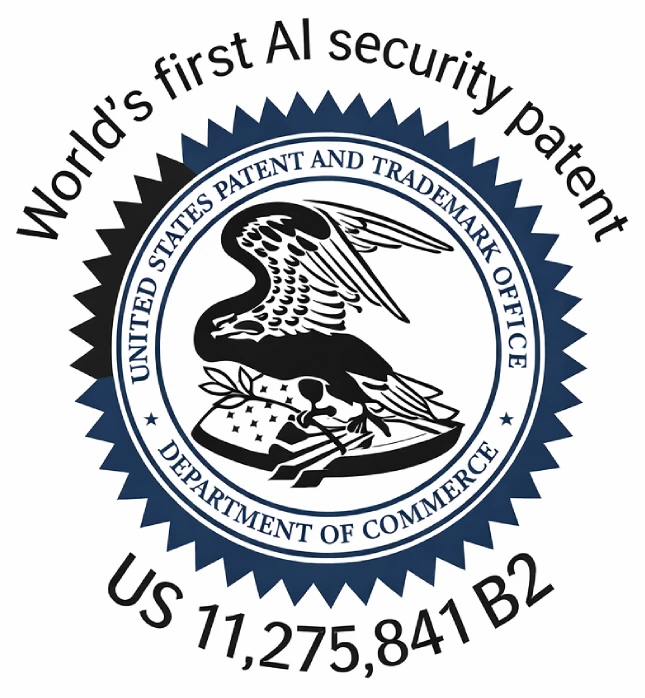
Standards leadership

A decade of adversarial research

20+ industry awards

20+ industry awards

[ Compliance ]

Compliance: built forwhat regulators want now

Regulators moved from “show me your AI policy” to “prove, per action, what your AI did, and that you could stop it.”

  • EU AI Act, Art. 12

    Required now — Automatic recording of AI actions across their lifecycle.

    What you get — Tamper-evident record of every action and the rule that allowed or blocked it.

  • EU AI Act, Art. 14

    Required now — A human must be able to intervene and stop.

    What you get — Pre-execution blocking is that intervention, not an after-the-fact alert.

  • DORA

    Required now — Fast incident reporting; agents may count as third-party ICT.

    What you get — Complete event chain to classify and report inside the reporting window.

  • SR 11-7

    Required now — Ongoing monitoring of production models.

    What you get — Continuous, queryable record of model-driven actions.

Expected by auditors and counterparties

NIST AI RMF, ISO 42001, SOC 2, Japan’s AI Guidelines for Business, Singapore’s Model AI Governance and MAS FEAT. They converge on the same demands: continuous monitoring, traceability, and a human in control. Mapped, evidenced, exportable in minutes.

[ Tailored Security for Every Role ]

Built for every team that owns the risk

For AppSec teams

  • See every prompt, tool call, and file touched, attributed to the human who initiated it. Make policy decisions with evidence.
  • Block the shape of dangerous behavior, not the wording. No more content-detection rules adversaries bypass next week.
  • Learn from real attack chains. When something gets blocked, see exactly which agent permissions or tool scopes need tightening.

For CISOs

  • Say yes to coding agent rollouts with evidence you can defend to the board and the regulator.
  • Move from “we don’t really know what these agents do” to a verified chain of who did what, why it was allowed, and what was blocked.
  • Contain blast radius. When something goes wrong, you have a complete chain of events to work from.

For engineering and platform leaders

  • Get a complete picture of how your developers use the coding agents you’ve approved: what those agents actually do, where the risk concentrates.
  • Catch coding agent mistakes before they execute: leaked secrets, dropped production tables, wrong packages installed.
  • One security platform across every coding agent your developers adopt, so nothing gets rebuilt when they switch tools.
  • First signal in minutes — no code changes, no workflow disruption.

For risk, compliance, and leadership

  • EU AI Act, NIST AI RMF, ISO 42001, SOC 2, SR 11-7: each mapped to controls, with evidence ready to export.
  • Tamper-evident record of every agent action and the policy that approved or blocked it.
  • Honest coverage reporting: we tell you what we see and what we don’t. Your risk register stays accurate.

[ Get a demo ]

See what your agentsactually do

Watch the platform turn individual agent actions into chains, stop the dangerous ones before they become the incident, and produce the evidence your auditors will ask for.

Form not loading? Open it in a new tab.

No code changes. Runs on your infrastructure or in the cloud, your choice.

The platform is in early access: pilots are scoped, observe-first, and run with the founding team.