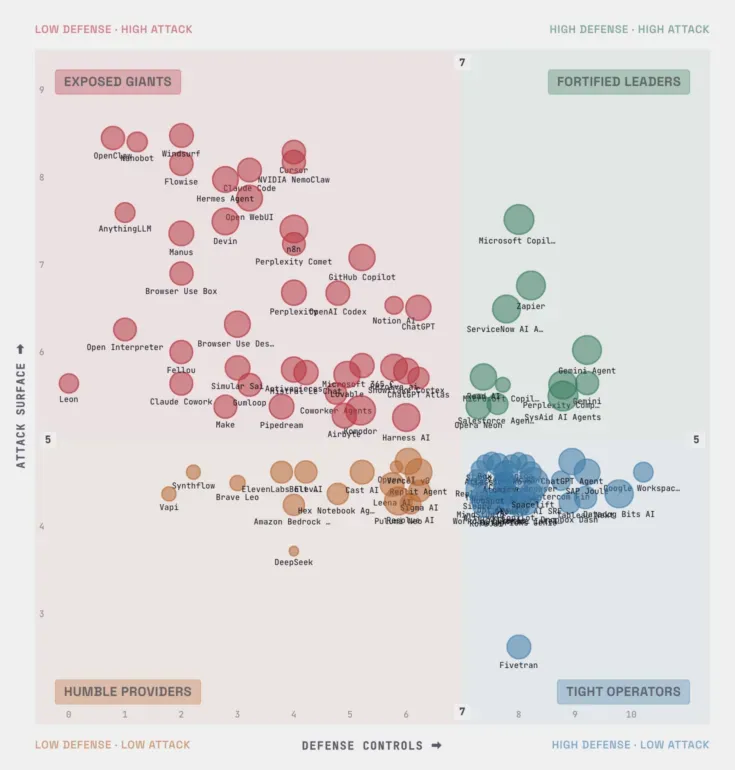
As generative AI continues to transform industries and reshape how we interact with technology, the security landscape surrounding these powerful systems has never been more critical. October 2025 saw a surge in both sophisticated attacks and innovative defense mechanisms, highlighting the ongoing cat-and-mouse game between security researchers and malicious actors. This digest compiles the most significant GenAI security developments, vulnerabilities, and defensive strategies from the past month, providing security professionals and AI practitioners with essential insights to protect their systems and data.
Statistics
Total Resources Tracked: 30 Distribution by Category:
- Security Incidents: 4 resources (13.3%)
- Vulnerabilities: 4 resources (13.3%)
- Security Research: 4 resources (13.3%)
- Defense Strategies: 3 resources (10.0%)
- Exploitation Techniques: 2 resources (6.7%)
- Red-Teaming: 2 resources (6.7%)
- Security Frameworks: 2 resources (6.7%)
- Security Tools: 2 resources (6.7%)
- Image Attacks: 2 resources (6.7%)
- Security Reports: 1 resource (3.3%)
- Training Resources: 1 resource (3.3%)
- Security 101: 1 resource (3.3%)
- Video Attacks: 1 resource (3.3%)
- Hacking Games/CTF: 1 resource (3.3%)
Content
GenAI Security Reports
Detecting Exposed LLM Servers: A Shodan Case Study on Ollama
Cisco’s security team demonstrates how exposed LLM servers can be discovered using Shodan, focusing specifically on Ollama deployments. The research reveals concerning patterns in how organizations are leaving their AI infrastructure vulnerable to discovery and potential exploitation. Read more
GenAI Security Incidents
The Ongoing Fallout from a Breach at AI Chatbot Maker Salesloft
A significant data breach at Salesloft, an AI chatbot manufacturer, continues to have ripple effects across the industry. The incident highlights the critical importance of securing AI systems and the sensitive customer data they process. Read more
North Korean Hackers Used ChatGPT to Help Forge Deepfake ID
North Korean threat actors leveraged ChatGPT’s capabilities to create sophisticated deepfake identification documents. This incident demonstrates how AI tools can be weaponized for identity fraud and social engineering attacks. Read more
Hacker Exploits Claude AI to Automate Cyberattacks on 17 Companies
A malicious actor successfully used Claude AI to automate and scale cyberattacks across 17 different companies. The incident raises concerns about AI-powered attack automation and the need for better safeguards against malicious use. Read more
Scammers Are Using Grok to Spread Malicious Links on X
Threat actors have begun exploiting Grok AI to distribute malicious links across X (formerly Twitter). The campaign demonstrates how AI chatbots on social platforms can be manipulated to facilitate phishing and malware distribution. Read more
GenAI Vulnerabilities
Multiple Model Guardrail Jailbreak via “Terminal Simulation” Tactic
Security researchers discovered a novel jailbreak technique that bypasses multiple LLM guardrails by simulating a terminal environment. The tactic works across various AI models, revealing a fundamental weakness in how guardrails interpret contextual framing. Read more
LangChainGo Vulnerability Allows Malicious Prompt Injection to Access Sensitive Data
A critical vulnerability in LangChainGo enables attackers to inject malicious prompts that can access sensitive data within applications. The flaw affects numerous applications built on this popular framework, requiring urgent patching. Read more
K2 Think AI Model Jailbroken Mere Hours After Release
The newly released K2 Think AI model was successfully jailbroken within hours of its public launch. The rapid compromise underscores the ongoing challenge of securing large language models against adversarial attacks. Read more
OWASP Warns of ‘Unbounded Consumption’ Risks in AI Models
OWASP has issued a warning about unbounded consumption vulnerabilities in AI models that can lead to resource exhaustion attacks. These risks can cause service disruptions and significant cost overruns for organizations deploying AI systems. Read more
GenAI Defense Strategies
Defense Against Prompt Injection Attack
Researchers present a novel defense-by-attack approach to protecting systems from prompt injection vulnerabilities. The GitHub repository provides practical implementation guidance for developers looking to harden their AI applications. Read more
Multi-Stage Processing Architecture: A Structural Defense Against Prompt Injection
This article introduces a multi-stage processing architecture designed to structurally defend against prompt injection attacks. The approach separates concerns and validates inputs at multiple layers, providing robust protection against manipulation attempts. Read more
Defending LLM Applications Against Unicode Character Smuggling
AWS security team reveals how Unicode character smuggling can be used to bypass LLM security controls. The blog post provides practical defensive measures to detect and prevent these sophisticated encoding-based attacks. Read more
GenAI Security Research
Mask-GCG: Are All Tokens in Adversarial Suffixes Necessary for Jailbreak Attacks?
This research paper investigates whether every token in adversarial suffixes is essential for successful jailbreak attacks. The findings could lead to more efficient detection and prevention of adversarial prompts. Read more
Automatically Jailbreaking Frontier Language Models with Investigator Agents
Researchers demonstrate an automated approach to jailbreaking frontier LLMs using investigator agents. The work highlights the scalability of adversarial attacks and the need for more robust defensive mechanisms. Read more
Turns Hostile: Interpreting How Emojis Trigger LLMs’ Toxicity
This research explores how seemingly innocent emojis can trigger toxic responses in large language models. The study reveals unexpected vulnerabilities in how LLMs process and interpret visual unicode characters. Read more
The Risks of Code Assistant LLMs: Harmful Content, Misuse and Deception
Palo Alto Networks Unit 42 examines the security risks associated with code assistant LLMs, including harmful content generation and potential misuse scenarios. The research provides crucial insights for organizations deploying AI coding assistants. Read more
GenAI Exploitation Techniques
Scott Kirby Promised Me A Refund—And United’s AI Chatbot Fell For It
A real-world demonstration of how social engineering can exploit AI chatbots, where a user successfully manipulated United Airlines’ chatbot by claiming false promises. This incident illustrates the vulnerability of customer service AI to authority impersonation attacks. Read more
The Trifecta: How Three New Gemini Vulnerabilities Allowed Private Data Exfiltration
Tenable security researchers uncovered three distinct vulnerabilities in Google’s Gemini across Cloud Assist, Search Model, and Browsing features. The combined exploitation of these flaws enabled attackers to exfiltrate private data, demonstrating the compound risk of multiple vulnerabilities. Read more
GenAI Red-Teaming
The Missing Semester of AI for Organizations #1: LLM Security
Hugging Face presents a comprehensive guide to LLM security red-teaming for organizations. The resource covers essential security practices that are often overlooked in enterprise AI deployments. Read more
LLM Attack on Zyxel Nebula AI
A detailed case study of a successful LLM attack against Zyxel’s Nebula AI infrastructure. The research demonstrates practical exploitation techniques and provides valuable lessons for securing enterprise AI systems. Read more
GenAI Security Frameworks
AI Security Shared Responsibility Model
This GitHub repository presents a comprehensive shared responsibility model for AI security, clarifying roles between cloud providers, platform operators, and application developers. The framework helps organizations understand their security obligations across the AI stack. Read more
OWASP GenAI Security Project – Threat Defense COMPASS RunBook
OWASP releases a practical runbook for defending against GenAI threats using the COMPASS framework. The resource provides actionable guidance for implementing security controls in generative AI systems. Read more
GenAI Security Training
LLM Red Teaming Masterclass - Prompt Injection, Jailbreaks & AI Security Attacks
A comprehensive video masterclass covering LLM red teaming techniques including prompt injection and jailbreaks. The training provides hands-on demonstrations of AI security attacks and defensive strategies for security professionals. Watch now
GenAI Security 101
OWASP LLM Top10
An accessible overview of the OWASP LLM Top 10 vulnerabilities that every AI developer and security professional should understand. The article breaks down each risk with practical examples and mitigation strategies. Read more
Fickling
Trail of Bits releases Fickling, a security tool for analyzing and detecting malicious code in pickle files commonly used in machine learning models. The tool helps identify potential backdoors and malicious payloads hidden in serialized Python objects. Read more
Prompt Injector
Blueprint Lab introduces Prompt Injector, an open-source tool designed to test AI applications for prompt injection vulnerabilities. The tool automates security testing and helps developers identify weaknesses before deployment. Read more
GenAI Image Attacks
OpenAI DALL-E3 Guardrail Jailbreak via “Debug Framework Simulation” Tactic
Researchers successfully bypassed DALL-E3’s safety guardrails using a debug framework simulation technique. The vulnerability demonstrates how contextual framing can circumvent image generation safeguards. Read more
Multimodal Prompt Injection Attacks: Risks and Defenses for Modern LLMs
This research paper explores prompt injection vulnerabilities specific to multimodal LLMs that process both text and images. The study provides insights into attack vectors and proposes defensive mechanisms for next-generation AI systems. Read more
GenAI Video Attacks
OpenAI Sora Guardrail Jailbreak via “Hypothetical Anatomy” Tactic
Security researchers demonstrate a successful jailbreak of OpenAI’s Sora video generation model using a hypothetical anatomy approach. The technique reveals gaps in content moderation for AI-generated video systems. Read more
GenAI Hacking Games & CTF
AI Test CTF OWASP Top 10
Hack The Box launches a Capture The Flag competition focused on the OWASP Top 10 for AI systems. This hands-on challenge provides practical experience in identifying and exploiting common AI vulnerabilities. Read more
Quick Outro
October 2025 reinforced a critical reality: as AI systems become more sophisticated and integrated into our daily operations, the attack surface expands exponentially. The 30 resources compiled in this digest reveal both the ingenuity of adversarial tactics and the community’s commitment to developing robust defenses. Security professionals must remain vigilant, continuously updating their knowledge and defensive strategies. Whether you’re a developer implementing AI features, a security researcher probing for vulnerabilities, or an organization leader making strategic decisions, staying informed about these emerging threats and solutions is no longer optional—it’s essential for responsible AI deployment in 2025 and beyond. For more expert breakdowns, visit our Trusted AI Blog or follow us on LinkedIn to stay up to date with the latest in AI security. Be the first to learn about emerging risks, tools, and defense strategies.
Subscribe for updates
Stay up to date with what is happening! Plus, get a first look at news, noteworthy research, and the worst attacks on AI—delivered right to your inbox.