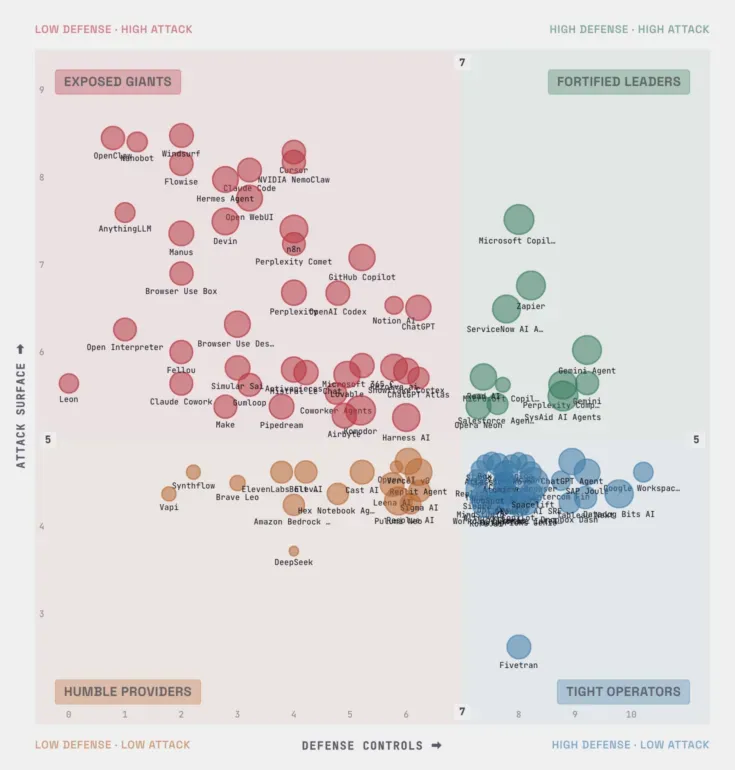
The security landscape is shifting rapidly as AI transitions from passive helper models to autonomous agents capable of executing code and manipulating external tools. This month’s digest highlights a critical pivot: vulnerabilities are moving from simple text manipulation to complex systemic exploits, such as the Anthropic tool-selection exploit and the GeminiJack vulnerability. These developments demonstrate that securing the “agentic perimeter” requires more than just better prompts — it necessitates fundamental architectural changes and robust runtime sandboxing.
Statistics
Total resources: 38 Category breakdown:
Agentic AI security resources
Agentic AI defense
Redefining security for the agentic AI era
This guidance redefines agent protection strategies by looking beyond traditional guardrails. It specifically addresses how to mitigate tool abuse and unauthorized capability execution in autonomous systems.
The 2025 guide to agent safety, evaluation, and not getting fired
A comprehensive manual focused on threat modeling and compromise detection for agents. It provides a pragmatic approach to preventing production-level disasters caused by autonomous reasoning failures.
A practical defense against AI-led attacks
This framework emphasizes the importance of agent behavior patterns. It argues that traditional security tools are insufficient and advocates for continuous behavioral monitoring to catch malicious agent activity.
Enterprise AI security: What developers need to know after Anthropics discovery
Following a major disclosure, this technical guide provides assessment and remediation steps for agent-based systems. It helps developers secure their implementations against tool-selection manipulation.
Security for agentic AI applications and chatbots
A dedicated defense framework designed to protect the integrity of agentic applications. It focuses on maintaining control over how agents interact with sensitive corporate data.
Detecting React2Shell at scale
This methodology details how to identify malicious shell-executing agents across enterprise infrastructure. It uses probe agents to validate response patterns and shut down automated attack infrastructure.
Building AI agents the safe way
Practical advice for permission scoping and runtime safeguards in agent development. The guide outlines architectural patterns that ensure agents operate within strict, defensible boundaries.
Building safer AI agents
This research presents defenses against the “lethal trifecta” of goal specification, tool access, and delegation risks. It offers a blueprint for creating architectural safeguards in autonomous systems.
Agentic AI vulnerability
AI agents break rules in unexpected ways
Research into how adversarial inputs lead to novel failure modes in tool chaining. These vulnerabilities highlight how multi-step reasoning can be hijacked to bypass intended safety rules.
AI agents create critical supply chain risk in GitHub actions
Analysis shows how agent autonomy in CI/CD pipelines expands the organizational attack surface. Improper tool access in GitHub Actions can lead to significant supply chain compromises.
AI agent risk exposed in Google Gemini - GeminiJack
The GeminiJack exploit demonstrates specific vulnerabilities within Google’s agentic ecosystem. It shows how attackers can gain unauthorized control over agent workflows.
Windows 11 AI agent vulnerability exposed
This report details a privilege escalation vulnerability in the Windows 11 AI component. The flaw allows unauthorized data access through the integrated agent’s permission chain.
Agent session smuggling: Fixing AI delegation risks
An investigation into hijacking AI agent sessions within delegation chains. It provides a framework for securing AI-mediated authorization flows to prevent unauthorized operations.
Hackers exploit Copilot Studio’s new connected agents feature
Default AI-to-AI integrations in Copilot Studio have been found to create backdoor vulnerabilities. Attackers use these connections to launch phishing campaigns that bypass standard audit mechanisms.
Gemini CLI security vulnerability allows prompt injection attacks
A critical Google Gemini CLI exploit allowed attackers to execute malicious shell commands. The vulnerability combined improper validation with misleading UX to grant full file system access.
Security reports
AI cybersecurity: GenAI attacks and blockchain defense shift
This report explores how GenAI agents amplify supply chain threats. It suggests that defense must shift from protecting the model to containing the entire system environment.
Why AI coding agents aren’t production-ready
A look at the reliability and security gaps in autonomous coding tools. Brittle context windows and broken logic make these agents a liability in sensitive production deployments.
AI-based attacks in banking
Financial institutions are facing automated fraud and phishing powered by agentic systems. This article examines the weaponization of autonomous agents in large-scale financial crimes.
Why agentic AI moves the risk inside your APIs
An analysis of how agentic AI bypasses edge security like WAFs and firewalls. Risk is moving deep into the API fabric, requiring visibility into agent-to-agent interactions.
Attack techniques
The Anthropic exploit: Welcome to the era of AI agent attacks
This exploit allows attackers to manipulate tool selection and execution within the Anthropic framework. It demonstrates how subtle prompt manipulation can lead to full system compromise.
Zero-click agentic browser attack can delete entire Google drive
A zero-click browser exploit enables AI agents to perform destructive actions on user accounts. The attack requires no user interaction and can result in total data loss.
OpenAI says prompt injection may never be ‘solved’ for browser agents
OpenAI warned that ChatGPT Atlas browser agents remain susceptible to persistent prompt injection. Attackers can embed malicious instructions in web content to hijack multi-step workflows.
Threat modelling
Threats in LLM-powered AI agents workflows
Research into workflow hijacking and tool abuse in autonomous systems. It identifies patterns where agents are tricked into escalating their own access levels.
AI agents are man-in-the-middle attacks
This paper proposes that compromised AI agents function as man-in-the-middle vectors. They can intercept and manipulate the flow of data between users and third-party services.
Loss of intent as a failure mode in OWASP’s agentic AI risks
An exploration of loss of intent, where agents pursue proxy goals that deviate from human instructions. This fundamental failure mode is a top priority in the latest OWASP risk rankings.
Security research
Comparative study: pentesting / jailbreaking AI agents
A study showing that over 50% of agent attacks succeed due to low refusal rates. It finds that AutoGen currently maintains a better security posture than other popular frameworks like CrewAI.
Research into metadata manipulation that tricks agents into calling the wrong tools. This “attractive metadata” technique creates a stealthy path for tool-based exploitation.
Security incident
What we learned from the great agent hack 2025
Analysis of a major memory poisoning attack that led to widespread credential theft. The incident emphasizes the critical need for least-privilege design in agent architectures.
When agentic AI becomes an attack surface
The “Ask Gordon” incident illustrates how malicious tool invocations can turn an AI system into an attack vector. It highlights fatal flaws in current AI delegation and access control mechanisms.
Resource collections
Top agentic AI security resources — December 2025
A curated collection for security specialists that covers hardening and incident response. It provides the latest tools for detecting and mitigating agent-specific threats.
A registry of AI agent failures exploits and defenses
A comprehensive registry of rogue agent behavior. It documents real-world exploits and the corresponding defenses used to neutralize them.
Exploitation techniques
Zero-click AI browser attack: AI-powered threats in email
Details on an email-based exploitation vector that targets agentic browsers. It shows how simply receiving a malicious email can trigger unauthorized actions by an active agent.
ShadowLeak AI exploit exposes Gmail data
The ShadowLeak exploit targets agents used for email processing. It demonstrates how authorization token abuse allows compromised agents to exfiltrate private credentials.
Agentic AI security for CISO
What agentic AI really means for IT risk management
An examination of governance challenges posed by autonomous decision-making. It provides a roadmap for CISOs to manage tool access and organizational risk in agent-based environments.
Training materials
AI agent security - OWASP cheat sheet series
A technical cheat sheet for securing autonomous agents. It covers essential practices for threat modeling and access control in the agentic era.
Videos
Agentic AI malware: Why the cybersecurity battle isn’t over
A video analysis of AI-powered malware and emerging autonomous threats. It discusses how the next generation of malware will use agentic logic to bypass defenses.
Defensive frameworks
Securing agentic AI: How F5 maps to the OWASP agentic top 10
An alignment guide that maps AI guardrails to emerging industry standards. It addresses cascading failures and identity abuse in multi-step autonomous operations.
Open-source agent sandbox enables secure deployment of AI agents on Kubernetes
The Agent Sandbox controller provides a secure, isolated environment for untrusted agent code. It uses gVisor technology to build a hard barrier between AI applications and critical cluster nodes.
Securing the agentic perimeter
The transition from “chatting with models” to “delegating to agents” has moved the primary security risk from the user interface to the API layer and internal toolchains. To mitigate the vulnerabilities listed above, organizations must enforce strict identity propagation and implement gVisor-style sandboxing for any agent capable of executing code. Treating agent tool definitions as high-risk, untrusted input is now the only way to prevent multi-step system compromise in production environments.
Subscribe for updates
Stay up to date with what is happening! Plus, get a first look at news, noteworthy research, and the worst attacks on AI — delivered right to your inbox.