Executive Summary:
“The Asana MCP incident exposed 1,000 organizations’ data through a single line of code, proving that when AI meets enterprise SaaS, yesterday’s security playbook is obsolete. This isn’t about one vendor’s mistake - it’s about an industry racing to deploy AI without understanding the fundamentally different threat model it creates.”
WHY Asana AI Incident Matters — Critical Business Impact
Key Impact Metrics:
- 1,000 organizations exposed (0.8% of Asana’s 130,000 enterprise customers).
- 34-day vulnerability window - Extended exposure period for sensitive data.
- $7.5M estimated remediation costs (based on industry averages for similar incidents).
- Zero evidence of exploitation - But compliance implications remain severe.
What Was At Risk:
- Strategic roadmaps and OKRs.
- M&A discussions and confidential projects.
- Sprint planning and technical documentation.
- Financial data and customer information.
- Cross-organizational data contamination affecting multiple enterprises simultaneously.
Why CISOs Should Care: This represents the first major documented AI integration protocol vulnerability in enterprise SaaS. The Model Context Protocol (MCP) powers AI integrations across ChatGPT, Claude, and Microsoft Copilot - meaning similar vulnerabilities likely exist in your environment today.
WHAT Happened during Asana AI Incident — Technical Breakdown
Asana launched an experimental MCP server on May 1, 2025 to enable AI assistants to query their Work Graph. A tenant isolation logic flaw allowed AI requests from Organization A to receive cached results from Organization B, creating cross-contamination without any external attack.
Technical Root Cause:
- Confused Deputy Bug: MCP server failed to re-verify tenant context for cached responses.
- Missing AI Identity Management: System relied solely on user tokens, not AI agent identity.
- Architectural Flaw: Long-lived TCP connections with inadequate session management.
- No Cross-Tenant Testing: QA missed concurrent multi-org query scenarios
WHO Was Involved in Asana AI Incident
| Role | Actor | Impact | | |
|---|
| Vendor | Asana | Detected internally, fixed, preparing post-mortem | | |
| Discovery | Asana SRE Team | Found June 4 via anomaly monitoring | | |
| Affected | ~1,000 enterprises | Including Fortune 500 (Spotify, Uber, Airbnb) | | |
| Security Researchers | Kellman Meghu (DeepCove), Trail of Bits, Invariant Labs | Identified protocol- wide vulnerabilities | | |
| Media | BleepingComputer, The Register, UpGuard | First public reporting June 18 | | |
WHEN Asana AI Incident happened — Critical Timeline
| Date | Event | Business Impact | | |
|---|
| May 1 | MCP server launches in beta | Vulnerability active | | |
| May 1 — June 3 | 34-day silent exposure window | Data bleeding between orgs | | |
| June 4 | Internal discovery | Immediate server shutdown | | |
| June 5-16 | 12-day remediation period | All AI workflows disrupted | | |
| June 16 | Direct customer notification | Compliance clock starts | | |
| June 17 | Service restored with manual reconnection | Business continuity restored | | |
| June 18-19 | Public disclosure | Reputation impact begins | | |
WHERE Asana AI Incident happened — Attack Surface Analysis
Primary Location: Asana’s multi-tenant cloud infrastructure.
Geographic Scope: Global - affected organizations across 190 countries.
Data Flow Points:
- AI query interfaces (ChatGPT, Claude, Copilot)
- MCP server cache layer
- Cross-tenant memory pools
- API gateway endpoints
HOW It Happened — Vulnerability Mechanics
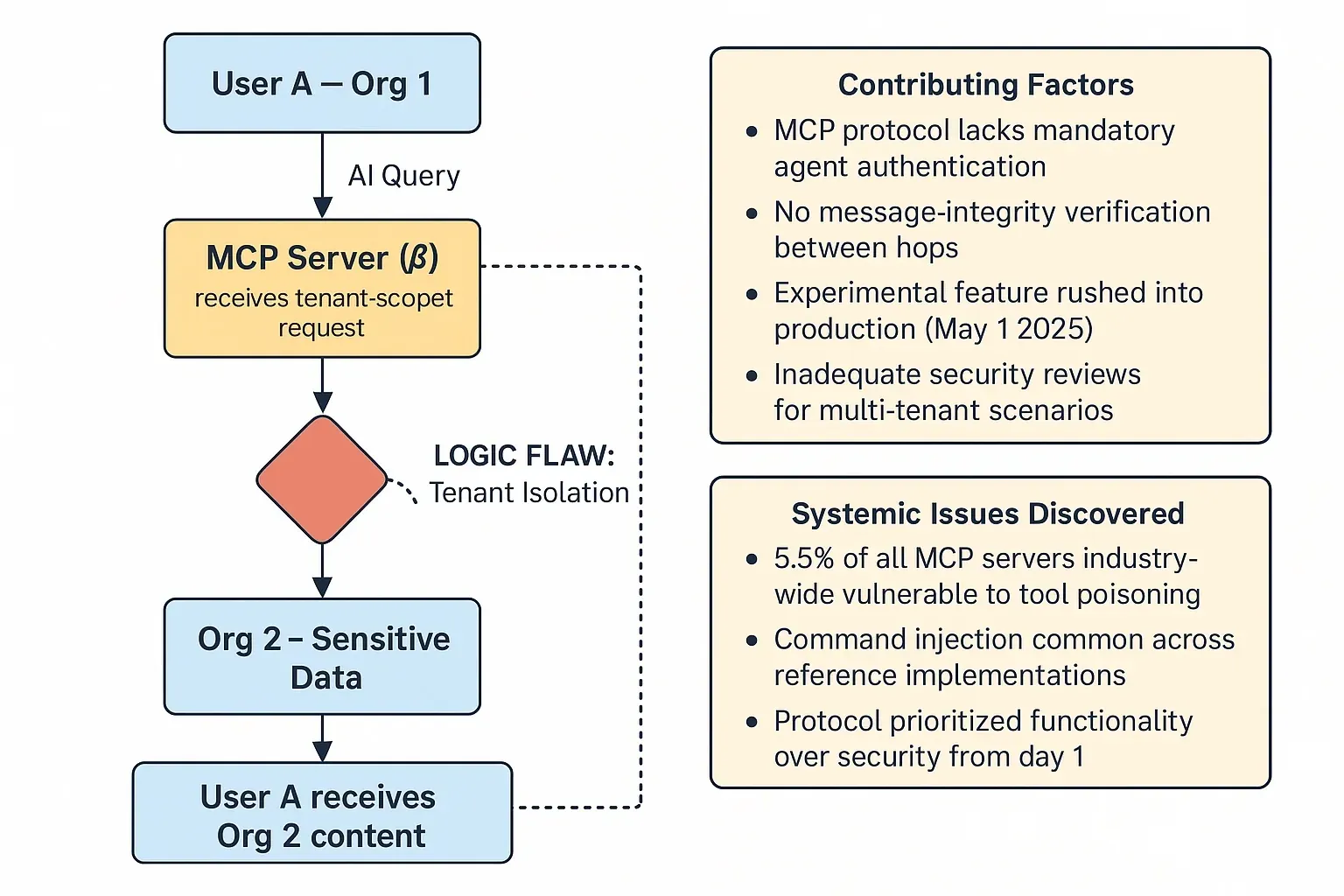
Cross-Tenant Data Exposure via MCP Server Logic Flaw
- Contributing Factors:
- MCP protocol lacks mandatory authentication
- No message integrity verification
- Experimental feature rushed to production
- Inadequate security review for multi-tenant scenarios
- Systemic Issues Discovered:
- 5.5% of all MCP servers vulnerable to tool poisoning
- Command injection common across implementations
- Protocol designed for functionality over security
HOW To Defend AI from similar incidents — CISO Action Plan
- Audit All AI Integrations
- Inventory every MCP connection in your environment
- Review access logs for anomalous cross-tenant queries
- Delete any unauthorized data immediately
- Enforce Tenant Isolation
- Implement explicit tenant ID validation
- Add cryptographic verification for all AI queries
- Deploy runtime security monitoring for context switching
- Reset AI Connections
- Force manual re-authentication for all AI tools
- Implement connection approval workflows
- Document business justification for each integration
Strategic Controls (30-90 Days)
- AI-Specific Security Architecture
- Deploy dedicated AI gateways with tenant isolation
- Implement mTLS for AI agent authentication
- Create separate data planes for AI vs human access
- Use SPIFFE IDs for non-human identity management
- Enhanced Monitoring & Logging
- Log all AI queries with full context (minimum 90 days)
- Implement anomaly detection for cross-tenant patterns
- Create AI-specific SIEM rules and alerts
- Deploy honeypots to detect confused deputy attacks
- Vendor Risk Management
- Update contracts to require 24-hour AI incident disclosure
- Mandate security assessments for AI features
- Include AI-specific clauses in DPAs
- Require vendor participation in kill-switch protocols
- Testing & Validation
- Implement cross-tenant fuzzing in CI/CD
- Conduct continuous AI red team exercises
- Test for tool poisoning vulnerabilities
- Validate tenant isolation under load
Long-Term Program (6-12 Months)
- AI Governance Framework
- Establish AI Security Review Board
- Create risk scoring for AI integrations
- Implement phased rollout for AI features
- Develop AI-specific incident response plans
- Technical Debt Reduction
- Migrate from TCP to authenticated REST APIs
- Implement zero-trust architecture for AI
- Deploy runtime application self-protection (RASP)
- Create immutable audit trails for AI actions
- Compliance & Legal Preparation
- Update incident response plans for AI scenarios
- Prepare regulatory notification templates
- Document AI data flows for privacy assessments
- Create AI-specific cyber insurance reviews
Regulatory landscape and legal implications
No evidence exists of SEC filings, FTC investigations, lawsuits, or formal regulatory responses as of June 2025, suggesting the incident either did not meet materiality thresholds for mandatory disclosure or regulatory action remains pending. This absence of formal regulatory response may indicate successful containment limiting legal exposure, though it could also signal future scrutiny as agencies become aware of the incident’s scope.
The incident likely did not trigger mandatory SEC disclosure requirements due to limited financial materiality—affecting less than 1% of Asana’s customer base with no disclosed material business impact. Bleeping Computer However, the cross-organizational data exposure could create privacy law implications under regulations like GDPR and CCPA for affected organizations.
The limited regulatory response contrasts with increasing government attention on AI security. CISA, NSA, and FBI recently released joint guidance on “AI Data Security: Best Practices,” while NIST is taking a larger role in AI standards setting. Search Security This suggests future incidents may face more stringent regulatory scrutiny as frameworks mature.
Expert Analysis & Industry Implications
“This is not an Asana problem — it’s an industry problem,” says Kellman Meghu, Principal Security Architect at DeepCove. “MCP is still in early development with security as an afterthought.”
Key Findings from Security Researchers:
- Trail of Bits: “Line-jumping attacks violate MCP’s core assumptions”.
- Invariant Labs: “Tool poisoning affects 1 in 20 MCP implementations”.
- CISA Advisory: “AI systems require fundamentally different security models”.
Regulatory Outlook: While no formal investigations have begun, experts predict:
- SEC may require AI risk disclosures in 10-K filings.
- GDPR implications for cross-border data exposure.
- Potential class-action litigation precedent.
- New AI-specific compliance frameworks by 2026.
Bottom Line for CISOs and future outlook
The Asana incident serves as a wake-up call for the industry about security risks in AI integration protocols. It demonstrates how the rapid pace of AI adoption can outpace security considerations, with “experimental” features deployed to production environments before comprehensive security validation.
Industry consensus is emerging on the need for secure-by-design AI integration standards. The incident has accelerated discussions about developing standardized security controls for AI systems and better integration between AI functionality and traditional security frameworks.
The cybersecurity community’s collaborative response—with transparent vulnerability research and shared best practices—provides a foundation for building more secure AI integration practices. However, the discovery of similar vulnerabilities across multiple MCP implementations suggests systematic challenges requiring industry-wide coordination to address.
The Asana incident proves that AI integration is the new attack surface. Every CISO must assume:
- Your AI integrations have similar vulnerabilities.
- Traditional security controls are insufficient.
- The window for proactive defense is closing rapidly.
Three Critical Takeaways:
- Tenant isolation failures in AI can instantly become supply chain attacks affecting multiple organizations
- “Experimental” AI features are being deployed to production without adequate security review
- The security community needs new frameworks designed specifically for AI threat models
For more expert breakdowns, visit our Trusted AI Blog or follow us on LinkedIn to stay up to date with the latest in AI security. Be the first to learn about emerging risks, tools, and defense strategies.
Subscribe for updates
Stay up to date with what is happening! Plus, get a first look at news, noteworthy research, and the worst attacks on AI—delivered right to your inbox.
Sources
Primary Incident Reports:
Security Research & Analysis:
Regulatory & Compliance:
Asana AI Incident: Comprehensive Lessons Learned for Enterprise Security and CISO